Household Chore Chart: One Chart for the Whole Home
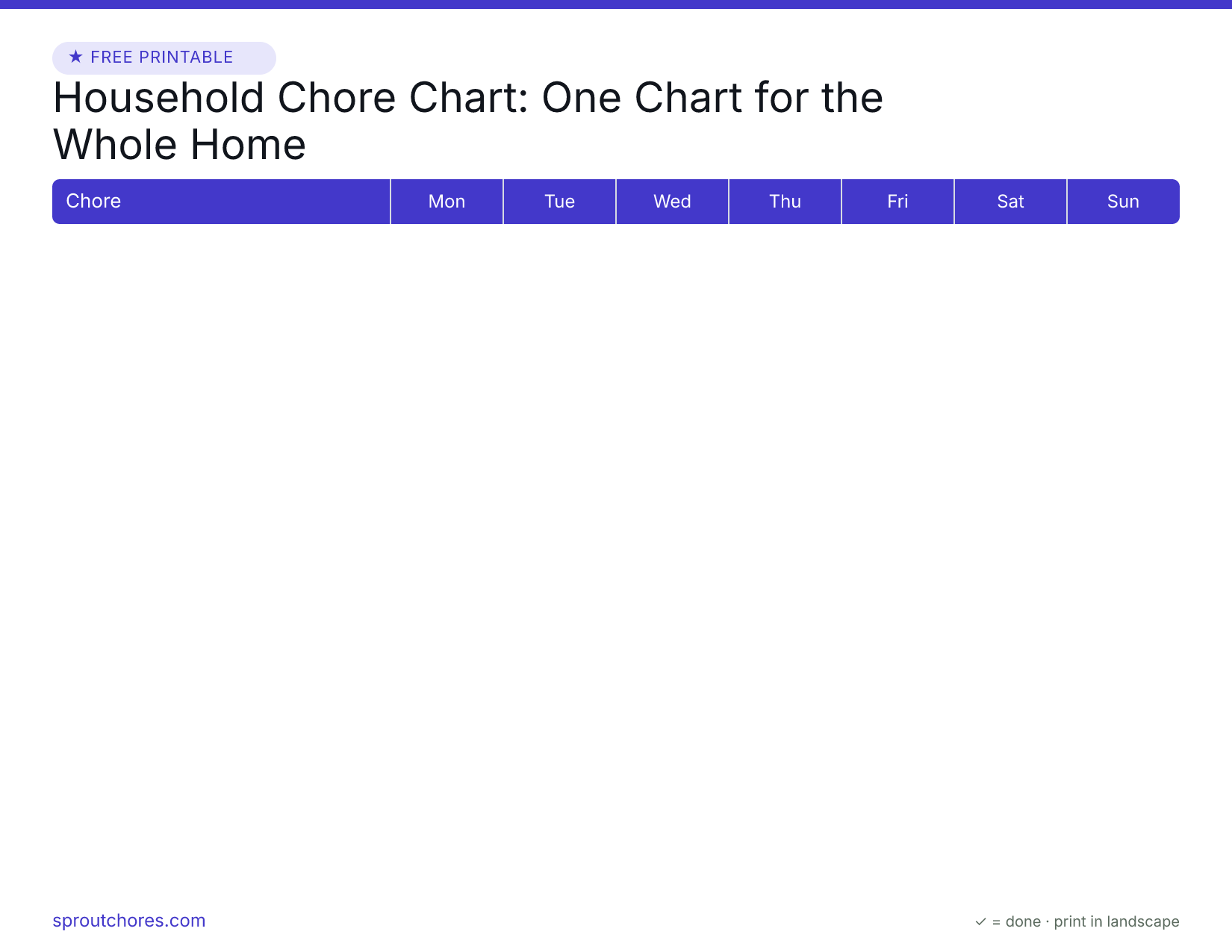
A household chore chart is the one place where the whole home's work stops being invisible. Instead of a vague, nagging sense that "the house needs cleaning," you get every room laid out in rows, a column for each person under the roof, and an honest picture of who's handling what. That's the whole idea here: not a kids' sticker board, but a fair-split tool for everyone who lives in the house — grown-ups included. I'm Andrew, and with my wife I've kept a busy home running for years: four kids between nine and eighteen, plus the foster children we've cared for along the way. The chart below starts blank on purpose — you fill in your own rooms down the side, add the people in your home across the top, then print it or keep tweaking it on screen. Below the generator I'll walk through how to organize a household chart by room, how to divide it so it actually feels fair, and how to build one that survives a rough week instead of collapsing the first time life gets in the way.
| Chore | Mon | Tue | Wed | Thu | Fri | Sat | Sun | Remove |
|---|
Tip: choose Landscape in the print dialog for the best fit.
Print in landscape for the best fit. A few reminders from our family to yours: do it together the first few times, keep the chart somewhere everyone can see it, and reward steady effort over a perfect job. — The SproutChores family
Want every age in one file? Get the free Age-by-Age Pack
Six printable charts (ages 4–10) plus reward and routine sheets, in one tidy PDF — free, straight to your inbox.
We email you new printables now and then — unsubscribe anytime. Privacy.
Something went wrong — please try again in a moment.
✓ Almost there — check your inbox!
We just emailed you a confirmation link. Click it to confirm, and your free Age-by-Age Chore Chart Pack lands in your inbox moments later.
Organize your household chart by room
On a whole-house chart, rooms make a better backbone than people or days do. When the rows are your actual rooms and shared zones — kitchen, main bath, living room, entryway, the endless laundry — and each person gets their own column, you can take in the entire home at a glance and see exactly where the work lives. That structure quietly settles the most common household standoff, the "wait, wasn't the kitchen yours this week?" argument, because every zone has a name and an owner instead of floating around as something-someone-should-handle.
A tip we've learned the hard way: build the chart around the house you genuinely live in, not the tidy one in your head. Put down the rooms that truly eat your time and leave off the ones that stay fine on their own. Group the little tasks under the room they belong to so the chart stays readable rather than turning into a wall of fifty checkboxes. The generator above is blank for exactly this reason — you write in your own rooms and the names of the people in your home, then print it or keep editing it as the household changes.
Split it so the house actually feels fair
The per-person columns are where a household chart earns its keep, because "fair" in a home has less to do with everyone doing an identical amount and more to do with the work being visible. A lot of household tension isn't really about a dirty tub — it's about one person silently carrying the whole mental map of what needs doing and when. Once every job is written under a name, that invisible tracking moves out of one head and onto a chart the household agreed to together.
Put the adults on the chart too. In our home the kids grow up watching that pitching in isn't a childhood tax they'll age out of — it's simply what everyone who lives here does, parents included. What each column holds should fit the person: a little one might own a couple of self-care and tidy-up jobs, a grade-schooler takes on shared spaces like the bathroom or the trash, and by the teen years we treat the work much more like the adult responsibility it's rehearsing for. And rotate the jobs nobody wants — when the worst chore in the house shifts from column to column, the whole thing stops feeling like one person drew the short straw for life.
It's a tracking tool, not a bribe
Here's the stance underneath every chart on this site: a household chore chart exists to give the grown-ups an honest read on how the home is running, not to dangle a prize in front of anyone. Think of it as the instrument panel, not the engine. We don't hand out stickers or pay by the task, because the moment a chore comes with a price tag people start weighing what they'll get for it instead of what the house needs. The motivation is meant to come from the plain expectation that this is a shared home and keeping it up is part of living in it.
We do have an allowance, but we deliberately keep it off to the side, away from the daily chart — it's tied to how well and how steadily someone works and the attitude they bring, not paid out chore by chore. And when a job genuinely needs doing right now, we've found that naming it a little ahead of time beats springing it on someone. "In a bit we'll tackle the kitchen" lands completely differently than a sudden order, and a posted chart does that advance warning for you: nobody's ambushed, because the week is already up on the wall for everyone to see. The deeper reason we bother with any of this is that a home is where you rehearse for running your own life someday — the real skill we're after isn't a spotless counter, it's becoming someone a household can count on.
Build one that survives a bad week
Most household charts don't die from a flaw in the design — they die on the first hard week. Someone builds an elaborate, perfect system, then a work trip or a stomach bug or the holidays roll through, the chart goes untouched for days, and everyone quietly concludes it doesn't work. The truer read is that it was never built to take a hit. The charts that last in a real home are the ones you can abandon completely and restart on Monday without guilt or a redesign, so aim for something simple enough to bounce back rather than something impressive enough to photograph.
Fostering taught us how much a predictable rhythm does for a household. When we took in little ones who'd never had dependable structure, a lot of what looked like resistance turned out to be plain uncertainty about what came next — and once the routine held steady, the friction faded. The same is true in a house full of your own kids and adults: a chart everyone can see takes the guesswork out of who does what, and that alone lowers the temperature. Start from the home you actually have, get the visible, restartable version working first, and adjust as you go. You're not chasing a flawless week — you're after steady progress you can keep.
Frequently asked questions
- How do I organize a household chore chart?
- Use your rooms as the rows and the people in your home as the columns. Listing each real room and shared zone down the side — kitchen, bathrooms, living areas, laundry — lets you see the whole home's workload at once so nothing slips through the cracks, while a column per person shows who owns what. Build it around the house you genuinely live in rather than an idealized one, group small tasks under the room they belong to, and post it somewhere everyone passes. The blank generator above lets you set up your own rooms and names in about a minute.
- How do you divide household chores fairly among the whole family?
- Fair usually means visible more than it means identical. Most of the friction in a home comes from one person quietly tracking everything that needs doing, so writing every job under a name on a shared chart moves that load off a single set of shoulders. Match each person's share to what they can handle — lighter, self-care jobs for the youngest, shared-space work for grade-schoolers, more adult-level responsibility for teens — and put the grown-ups on the chart too. Rotating the least-loved chore so it doesn't live in one column forever helps a lot as well.
- Should adults be included on a household chore chart?
- Yes — in our house that's the whole point of calling it a household chart instead of a kids' chart. When children watch their parents hold a column and do their share, keeping the home up reads as something everyone who lives there does, not a phase you outgrow. It also keeps the chart honest as a picture of the entire home's workload, and it models the real reason chores matter at all: a home is where you practice becoming someone others can depend on.

About the author
More free printables
Get the free Age-by-Age Chore Chart Pack
Six printable charts (ages 4–10) plus reward and routine sheets, in one tidy PDF. We'll also send new printables and the occasional real parenting tip. The charts on this site are always free — no sign-up needed.
We email you new printables now and then — unsubscribe anytime. Privacy.
Something went wrong — please try again in a moment.
✓ Almost there — check your inbox!
We just emailed you a confirmation link. Click it to confirm, and your free Age-by-Age Chore Chart Pack lands in your inbox moments later.