Reward Chart for Adults: A Habit Tracker That Works as a Mirror, Not a Prize Wheel
If you searched for a reward chart for adults, you're probably not after a sticker board, you want a simple, honest way to see whether the thing you keep meaning to do is actually happening. Maybe it's exercise, maybe it's the chores that quietly pile up, maybe it's a set of routines that keep a busy or easily-distracted brain on the rails. The generator on this page builds exactly that: an editable grid with your own goals down one side and the days of the week across the top, a star to fill in for each one you finish, and plenty of room to leave most of it blank. I'm Andrew, a dad of four and a foster parent, and someone whose attention runs quiet and wandering rather than hyper, so I've spent years hunting for systems that survive a real week instead of a perfect one. Before you fill yours in, I want to be straight about how a chart like this actually earns its keep, because most of the advice around them has it backwards. Used well, a reward chart for a grown-up isn't a machine that bribes you into moving. It's a mirror. It shows you the plain truth of your week so you can decide what to adjust, and a small reward can give a brand-new habit a nudge while it's still fragile. The sections below cover how to set one up, how to pick rewards that help instead of hook, and when to let the chart fade once the habit can stand on its own.
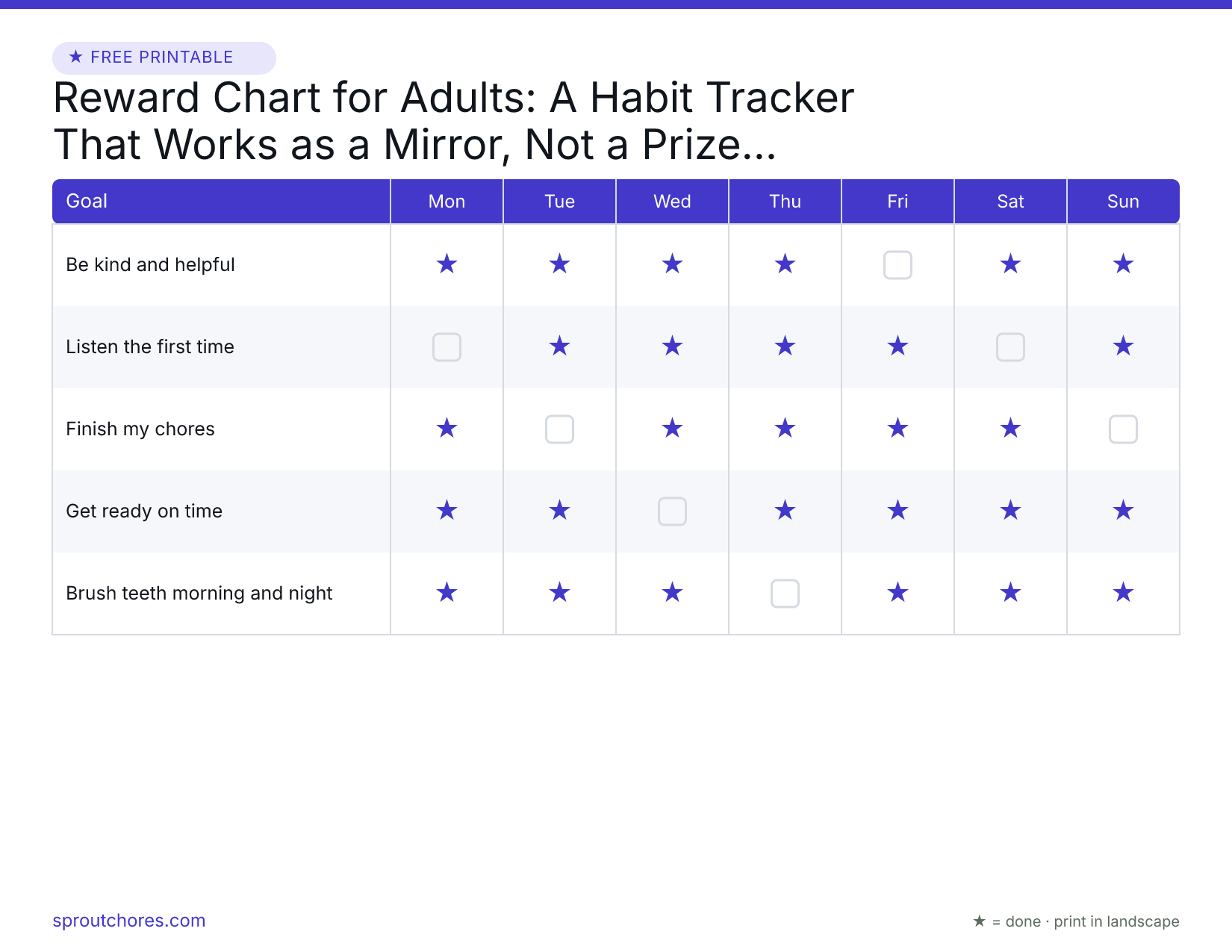
| Goal | Mon | Tue | Wed | Thu | Fri | Sat | Sun | Remove |
|---|---|---|---|---|---|---|---|---|
| Be kind and helpful | ||||||||
| Listen the first time | ||||||||
| Finish my chores | ||||||||
| Get ready on time | ||||||||
| Brush teeth morning and night |
Tip: choose Landscape in the print dialog for the best fit.
Print in landscape for the best fit. A few reminders from our family to yours: do it together the first few times, keep the chart somewhere everyone can see it, and reward steady effort over a perfect job. — The SproutChores family
Want every age in one file? Get the free Age-by-Age Pack
Six printable charts (ages 4–10) plus reward and routine sheets, in one tidy PDF — free, straight to your inbox.
We email you new printables now and then — unsubscribe anytime. Privacy.
Something went wrong — please try again in a moment.
✓ Almost there — check your inbox!
We just emailed you a confirmation link. Click it to confirm, and your free Age-by-Age Chore Chart Pack lands in your inbox moments later.
How to build a reward chart for adults that survives a real week
The version of an adult reward chart that quietly dies is almost always the ambitious one, a dozen goals, every box begging to be filled, built for the person you wish you were by Friday. A page like that is intimidating just to look at, and the first hard week buries it. So start smaller than feels satisfying. Put two or three things on the grid, write each one so concretely there's nothing to interpret, walk 20 minutes beats exercise, dishes before bed beats tidy up, and leave most of the week blank on purpose. A sparse chart is one you'll actually open again tomorrow.
A few things have made mine stick where willpower alone never did, and they come straight from living with an attention span that likes to wander. I keep the same handful of goals in the same spots every week, so my brain runs a familiar pattern instead of re-deciding everything each morning. I aim the demanding stuff at the hours my focus is genuinely sharp, I'm useless after dark, so anything that needs a running start goes early; if you come alive at night, flip that without apology. And I treat the chart as memory that lives outside my head, because if a goal only lives in my head I may as well count it forgotten, so getting it onto the page is half the battle. The last piece is making the thing restartable. Life will knock it over, a trip, a bad stretch, a week that just gets away from you, and the chart that lasts isn't the one with the longest streak, it's the one you can pick back up cold on Monday without auditing the wreckage. Print a fresh one and begin again with two lines. That isn't the system failing, that's the design working.
Treat the chart as a mirror, not a prize wheel
Here's the belief that runs under everything on this page, and it's the same one my wife and I use with our kids, just pointed at a grown-up: the chart isn't there to make you behave. Its real job is to show you, honestly, what your week actually looked like. Full or empty, the grid is a mirror, a glance tells you which habit is quietly slipping and which one has taken root, so you can adjust instead of guess. That sounds modest, but for most of us the honest picture is the whole fix. We remember the good weeks and blur out the missed days; a chart simply won't let you.
Where a reward comes in is narrower than the marketing suggests. A small prize can give a brand-new habit a push while it's still forming, the way training wheels help until balance shows up. But an adult who hands himself a treat for every box he ticks builds a fragile little economy, and the moment the reward loses its shine, or a rough week makes it feel unearned, the whole thing stalls. Motivation that actually lasts comes from somewhere quieter: the plain payoff of a life that runs, a body that feels better, a home you're not fighting, the steady self-respect of being someone who does what he said he would. I learned this in reverse, honestly, a brain like mine tends to chase whatever feels least unpleasant right this second, which is exactly why an outside reward can help for a while and exactly why it can't be the engine. So let the chart be the mirror, let the reward be a temporary nudge, and don't let the two get confused.
Choosing a reward that helps instead of hooks
If you do wire in a reward, its design matters more than the chart, and the cheap, frequent, low-stakes ones age the best. Something small you can hand yourself often, a good coffee, the next episode of the show you're rationing, an hour with a book, a Saturday outing, beats a big-ticket prize dangled weeks away. Experiences and small choices tend to build something; another object usually just ends up in a drawer. And keep the reward roughly proportional to the effort, not to how much you were dreading the task.
Two lines are worth drawing clearly. First, don't reward yourself box by box. Tie any treat to a decent stretch, a week you mostly showed up for, rather than a per-star payout, because a per-task fee trains you to tick boxes instead of to follow anything through. Second, keep the reward lane well away from the things you do simply because your life depends on them. The baseline upkeep, the dishes, the bills, the basic running of your home, isn't something you should have to bribe yourself into, any more than I get a prize for cooking dinner; that belongs on the plain side of the ledger with no star attached. Reserve the reward track for the one or two genuinely new habits you're trying to build right now. This is especially freeing with something like exercise: string a few weeks together and you'll usually notice the visible run of stars has quietly become the reward, because seeing the streak motivates you more than whatever you first promised yourself, which is the mirror doing its real work.
When to let the reward chart fade
A reward chart is scaffolding, and scaffolding is meant to come down. The signal is a quiet one: the habit has gone automatic, you stop checking the grid, and the reward you set has become an afterthought you keep forgetting to collect. That isn't the system failing, that's it finishing its job. When a habit no longer needs the prize, the prize is done, so wean it off that one goal, then let the row drop away and hand the space to whatever's still wobbly. Fade the reward before you retire the whole chart, so the habit gets a chance to prove it can stand on its own.
A couple of cautions from a house that has run a lot of these. Don't yank the support after a single good week, give the new habit real time to set. And don't read the inevitable rough patch, the holiday or the sick stretch where the chart falls off the fridge entirely, as proof you can't do this; the systems that survive in real life are simply the ones you can dust off and restart in five minutes. The deepest version of this I learned nowhere near a habit tracker. Fostering young children who'd never known a dependable daily rhythm, we watched what first looked like defiance turn out to be kids who just had no idea what was coming next, and it was a steady, repeated routine, not any reward, that finally settled them, because what they were really after was to feel safe and like they belonged. Grown-ups aren't so different. The chart and its stars can carry a habit through its fragile first season, but the thing that makes it stick is the quieter sense that this is simply who you are now and how your life works. Once that's true, the chart has worked itself out of a job, and you'll usually only notice by looking back, not day to day.
Frequently asked questions
- Do reward charts actually work for adults?
- They can, but usually not the way you'd expect. In my experience the reward itself doesn't create lasting motivation for a grown-up any more than it does for a kid, what a chart is genuinely good at is showing you an honest picture of your week, which habit is holding and which is slipping, so you can adjust. Used as a short-term nudge, pointed at one or two specific new habits and kept apart from the everyday upkeep you'd do anyway, a small reward can help a habit take hold while it's still fragile. Just don't expect the stars to carry it forever; the pull that lasts comes from the life the habit builds, not the prize at the end of the row.
- What's the best reward chart for an adult with ADHD?
- The best one is short, concrete, and forgiving, and this is lived experience for me rather than medical advice, so treat it as one person's approach, not a treatment plan; for anything clinical, talk to a qualified professional. What helps a brain that wanders: put only two or three goals on the page so it doesn't overwhelm you, write each as a small finishable action instead of a vague intention, keep the same goals in the same slots so you're running a pattern rather than re-deciding daily, and use the chart as memory outside your head, since whatever stays inside it tends to evaporate. Make it dead easy to restart after a bad week, because there will be bad weeks. A small reward can nudge a new routine along, but the chart's steadiest value for me is simply seeing, without self-deception, whether the thing actually happened.
- What are good rewards to put on an adult reward chart?
- Small, frequent, and low-drama beats big and far-off. Something you can give yourself easily and often, a nice coffee, an episode of a show, time with a book, a little weekend outing, keeps the chart light instead of turning it into a high-stakes negotiation with yourself. Lean toward experiences and small choices over another object that ends up forgotten in a drawer, and tie the treat to a solid stretch of showing up rather than a payout for every single box. And keep it off your non-negotiables: don't bribe yourself to pay the bills or wash the dishes. With something like an exercise chart, you'll often find the streak becomes its own reward, once you can see a run of filled-in days, not breaking the chain tends to motivate you more than whatever you first promised yourself.

About the author
More free printables
Get the free Age-by-Age Chore Chart Pack
Six printable charts (ages 4–10) plus reward and routine sheets, in one tidy PDF. We'll also send new printables and the occasional real parenting tip. The charts on this site are always free — no sign-up needed.
We email you new printables now and then — unsubscribe anytime. Privacy.
Something went wrong — please try again in a moment.
✓ Almost there — check your inbox!
We just emailed you a confirmation link. Click it to confirm, and your free Age-by-Age Chore Chart Pack lands in your inbox moments later.