Chore Chart for Teens: A Free Printable With a Money Column
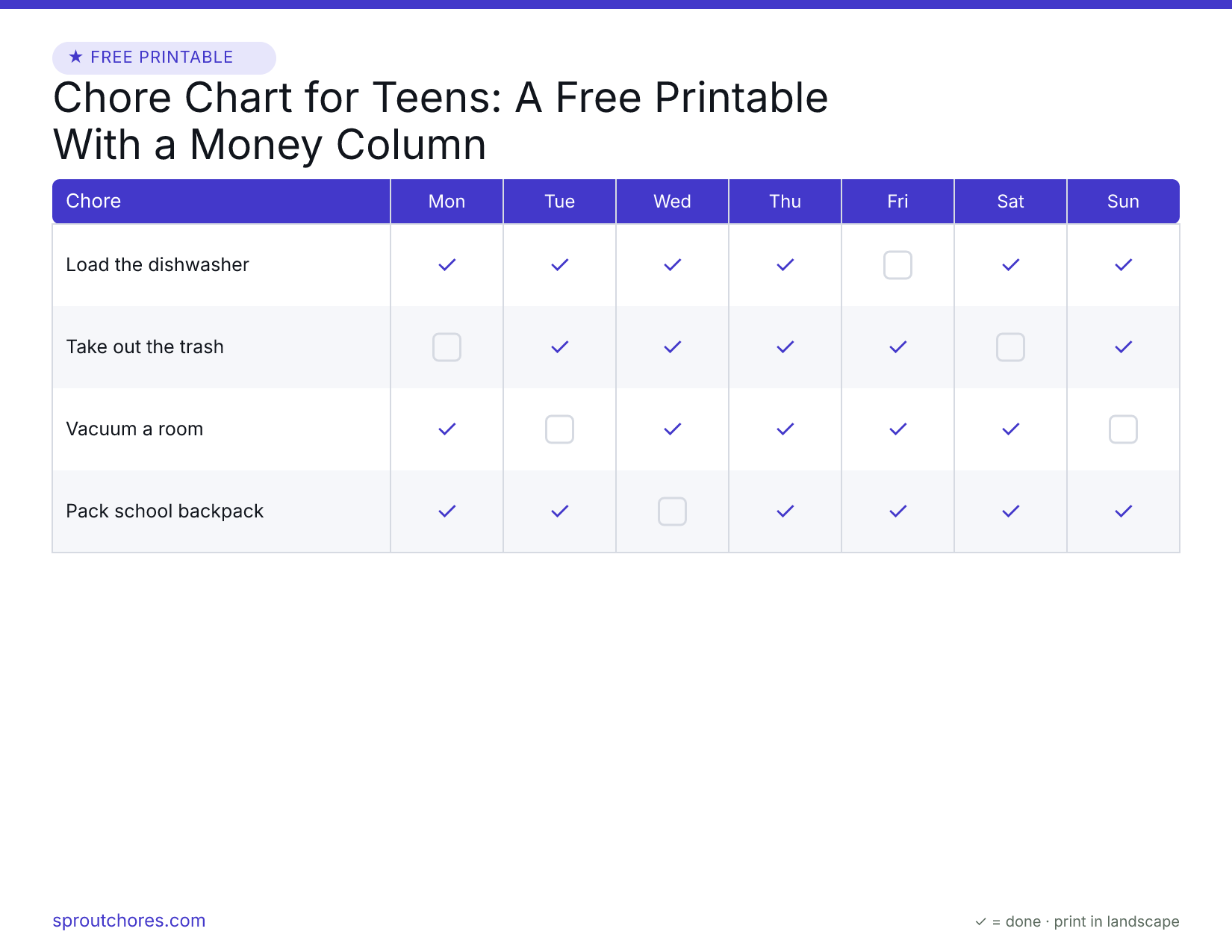
If you came looking for a chore chart for teens, you've probably already discovered that the cheerful sticker grids aimed at little kids land with a thud somewhere around age thirteen. A teenager doesn't need a cartoon broom telling them to sweep, and they'll spot a babyish chart from across the kitchen. So the printable below is built differently. It's editable, plainly worded for ages thirteen to seventeen, and it has a money column you can switch on with a weekly total that adds itself up. I'm Andrew, and my wife and I are the SproutChores family. We're raising four kids between nine and eighteen, two of them squarely in the teen years right now, and we've fostered along the way too. Before you print anything, I want to be straight with you about the money part, because that's the question that brings most parents to a page like this. We do hand our teens money, but not the way you might expect, and I think the how matters more than the dollar amounts. The sections below walk through pricing a teen's chores without turning your house into a billing department, drawing the line between the jobs that are just part of belonging here and the optional work worth paying for, and using all of it to build money sense before they cash a real paycheck. One thing to hold onto from the start: this chart is your tool for keeping an eye on how each kid is doing, not a machine for making a teenager care.

| Chore | Value | Mon | Tue | Wed | Thu | Fri | Sat | Sun | Remove |
|---|---|---|---|---|---|---|---|---|---|
| Load the dishwasher | |||||||||
| Take out the trash | |||||||||
| Vacuum a room | |||||||||
| Pack school backpack | |||||||||
| Weekly total | 0.00 | ||||||||
Tip: choose Landscape in the print dialog for the best fit.
Print in landscape for the best fit. A few reminders from our family to yours: do it together the first few times, keep the chart somewhere everyone can see it, and reward steady effort over a perfect job. — The SproutChores family
Want every age in one file? Get the free Age-by-Age Pack
Six printable charts (ages 4–10) plus reward and routine sheets, in one tidy PDF — free, straight to your inbox.
We email you new printables now and then — unsubscribe anytime. Privacy.
Something went wrong — please try again in a moment.
✓ Almost there — check your inbox!
We just emailed you a confirmation link. Click it to confirm, and your free Age-by-Age Chore Chart Pack lands in your inbox moments later.
Why a Teen Chart Looks More Like a Job Than a Sticker Sheet
The reason teenagers shrug at a standard chore chart is that the format is solving the wrong problem. A young child needs to be shown what a task even is and reminded it exists. A fifteen- or sixteen-year-old already knows how to run the dishwasher, fold their own laundry, and clean a bathroom properly; capability stopped being the issue years ago. What you're actually coaching now is the part nobody hands you for free in your twenties, which is finishing what you started, holding a real standard without being watched, and not having to be told the same thing three times. That's why the printable here drops the icons and keeps the wording adult. It reads like a list of responsibilities because that's what it is.
The mental shift that helped me most was to stop treating chores as a way to get the house cleaned and start treating them as rehearsal for being an adult. The clean kitchen is a nice side effect; the real product is a young person who can carry a job from beginning to end on their own. By the teen years that rehearsal is nearly over, so I run it more like a first job than a checklist. Our teens know what they're responsible for, they know I'll help anytime they ask, and they also know I'm not going to chase them around the house reminding them. When the follow-through slips, I let the consequence land rather than rescuing them from it, because a consequence that mirrors how the real world actually works is the only kind that teaches anything. A lecture they can nod through and tune out never changes a thing.
How to Price a Teen's Chores Without Running a Billing Department
The chart gives you a column for dollar amounts and a total at the bottom of the week. What it can't decide for you is whether to pay per task at all, and here's where I'd urge you to slow down, especially with a teenager. The moment a sharp sixteen-year-old can see that one job pays more than another, they will quietly do the math and skip whatever isn't worth their hourly rate. That's not laziness; that's exactly the rational behavior you accidentally invited by stapling a price to each line.
What has worked far better in our house is to tie money to the whole picture rather than to individual checkboxes. With our teens it functions almost like a monthly arrangement: a set amount they can count on, attached not to which boxes got ticked but to whether the work held up, whether they stayed dependable without constant prodding, and whether they brought a decent attitude to it. Let things drift over the month and the figure comes down when the month closes. Let it really fall apart and the money pauses until they string together a couple of reliable weeks and earn the trust back. Crucially, that money is for the extras a teenager wants, the coffee runs and the things they've been eyeing, never for anything they actually need, because we cover the needs no matter what. Funding wants is what gives the arrangement teeth; losing it stings in a way that losing a payment toward a necessity never should. If you'd rather use the chart's money column as a simple weekly record instead, that's perfectly fine. Just read the number as a snapshot of how the week went overall, not an invoice you owe job by job.
Family Chores Stay Free, and Why That Line Is Worth Keeping
Some of the work in your house was never going to be for sale, and it's worth saying that out loud to a teenager who's old enough to argue the point. Clearing your own plate, keeping your room from becoming a hazard, looking after the pet you talked us into; those belong to everyone living under this roof. My wife and I aren't paid to cook dinner or keep the lights on, and the kids aren't paid for the basic upkeep of the life we all share. You pitch in because the household is counting on you, full stop. I grew up with chores I never saw a dime for, and my parents had that part exactly right. Contributing isn't a transaction; it's simply the cost of being part of a family.
The paid work sits on top of that baseline as a separate thing. When a genuinely optional, larger job comes up, the kind I might otherwise hire out or sacrifice my own weekend to do, that's fair to pay a teen for directly, the same way an employer pays for extra value. When you set up your own chart, I'd actually mark which lines are the unpaid duties of belonging here and which are the paid extras, so the dollar column never quietly converts ordinary membership into something your teenager expects a fee for. Keep this lane clear of two others while you're at it. We don't make our kids earn screen time by doing chores, and we don't yank money away as punishment for unrelated misbehavior. Money, screens, and discipline each work better as their own honest conversation. Braid them together and a clever teenager will turn every request in the house into a negotiation, which is the last thing you want once they're old enough to be good at it.
Using the Money Column to Build Habits Before the First Paycheck
Once a teenager can watch a real number grow at the bottom of the page, you've got a teaching tool that has almost nothing to do with chores anymore. A teen is only a year or two from a job, a bank account, and a card with their own name on it, and the habits they bring to that moment are mostly the ones they're practicing now. The chart's weekly total turns vague effort into something concrete enough to plan around, which is where the lesson actually lives.
I lean into that on purpose. We talk plainly about what the money is for, the wants and the splurges, with the needs handled regardless, so a teen has a reason to think before spending instead of treating every dollar as already gone. I'll also nudge them to pick something worth saving toward and notice how many solid weeks it takes to get there; the value of being consistent clicks in a way no speech from me ever delivers. The deeper move, though, is what I learned watching my own kids and the foster children we cared for: the tools and information have to become theirs, not mine. I hand a teenager what works, make plain where their responsibility starts and stops, and let them decide whether to use it. I don't try to win the argument that my system is correct. If they ignore it for a while and feel the pinch, that's allowed, because now they at least know what good looks like and can choose it when they're ready. The point of a money chart for a teen was never to bribe cooperation out of them. Cooperation comes from the plain expectation that everyone here pulls their weight. The money is just a clean, low-stakes runway for the financial decisions they'll be making on their own a lot sooner than feels comfortable.
Frequently asked questions
- How much should I pay a teenager for chores?
- There's no universal rate, and honestly I'd steer you away from a per-task rate at all for a teen, because they'll just price out which jobs are worth their time and skip the rest. In our house teenagers get a dependable set amount that rides on the whole picture, the quality of the work, staying consistent without being chased, and the attitude they bring, rather than a dollar figure stapled to each chore. We keep that money strictly for wants and not needs, which is what makes it matter to them. If you'd rather use the chart's money column as a simple record, treat the total as a read on how the week went, not a bill you owe line by line.
- What chores should a teenager be responsible for?
- By the teen years the question isn't really what they're capable of, since a thirteen-to-seventeen-year-old can handle just about anything in the house, cooking a real meal, running their own laundry start to finish, dishes, trash, keeping shared spaces livable, and pitching in on bigger weekend projects. What you're coaching at this age is the standard and the follow-through: doing the job properly and finishing it without a second reminder. The printable here keeps the wording plain and grown-up so it reads like the responsibility list it actually is rather than something built for a small child.
- Should I tie my teen's allowance or chores to screen time?
- In our experience, keep those lanes apart. We don't make our kids earn screen time by doing chores, and we don't take money away as a penalty for unrelated behavior. Money, screens, and discipline each work better handled on their own terms. Tangle them together and a teenager will turn every single thing in the house into a bargaining chip, which gets exhausting fast once they're sharp enough to be good at it. Let the chores be a plain expectation of belonging here, let the money ride on overall follow-through, and handle behavior separately.
- My teenager thinks a chore chart is babyish. Is it still worth using?
- It can be, as long as you reframe what it's for. With teenagers the chart gradually becomes less of a guide for them and more of a dashboard for you, a quick way to see who's keeping up so you know when to step in. The motivation itself should come from the plain expectation that everyone in the family contributes, not from the chart. This printable is deliberately stripped of cartoons and written in adult language so it reads like a job's responsibility list, which most teens find a lot easier to take seriously than a sticker grid.

About the author
More free printables
Get the free Age-by-Age Chore Chart Pack
Six printable charts (ages 4–10) plus reward and routine sheets, in one tidy PDF. We'll also send new printables and the occasional real parenting tip. The charts on this site are always free — no sign-up needed.
We email you new printables now and then — unsubscribe anytime. Privacy.
Something went wrong — please try again in a moment.
✓ Almost there — check your inbox!
We just emailed you a confirmation link. Click it to confirm, and your free Age-by-Age Chore Chart Pack lands in your inbox moments later.