Chore Chart With Money: Assign a Dollar Value to Each Job
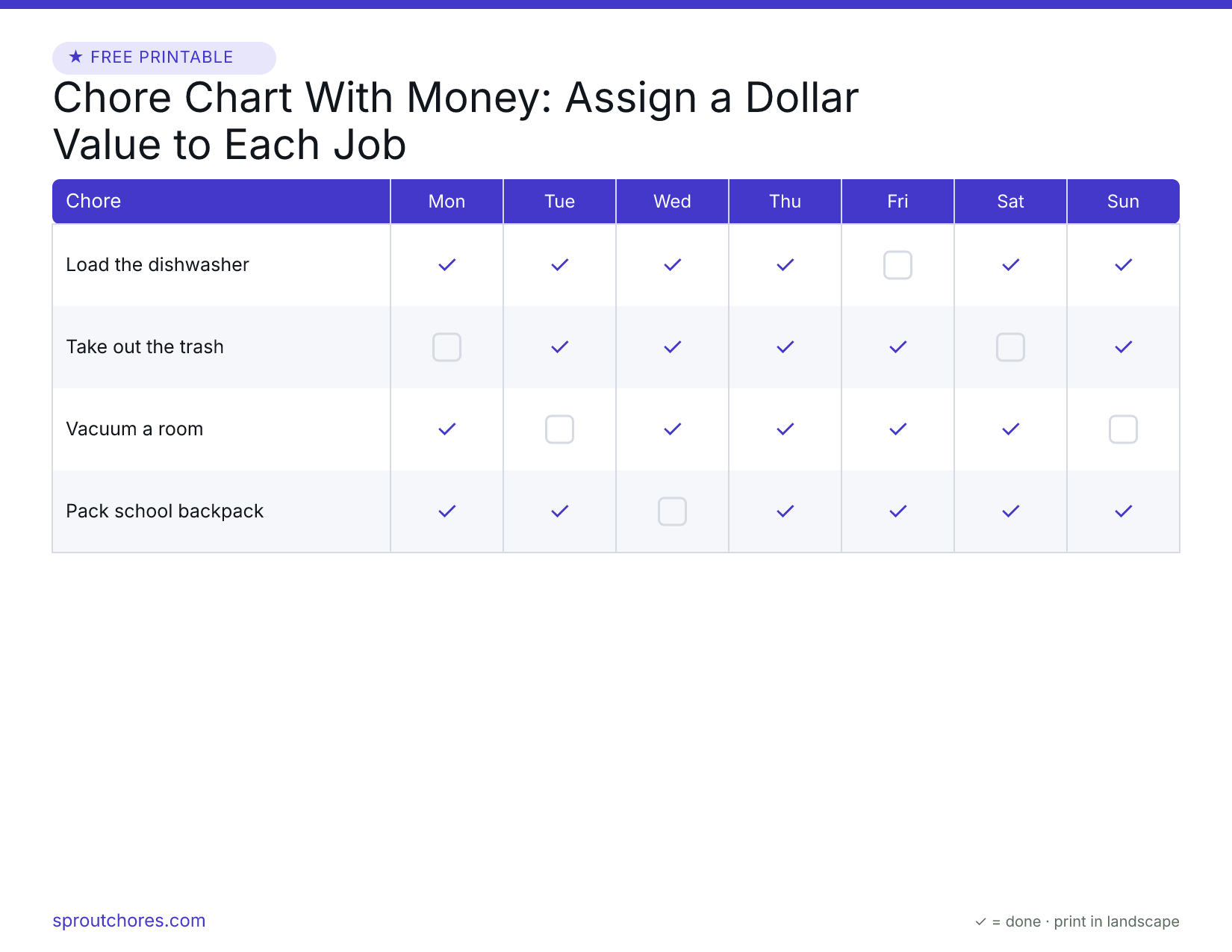
If you searched for a chore chart with money, you probably want one thing the basic charts skip: a column where a dollar amount sits right next to each job, plus a running weekly total your child can actually see add up. The editable chart below does exactly that. Type in your own chores, set the value beside each one, and it tallies the week for you, no math on your part and nothing to redo by hand. Before you start filling it in, though, I want to share how we actually handle money and chores in our house. I'm Andrew, a dad of four (ages 9 to 18) and a foster parent, and the short version is this: we use a chart like this as a tool for the parents to keep track of how each kid is doing, not as a vending machine where work goes in and cash comes out. How you decide to attach money matters as much as the numbers themselves, so the sections below cover pricing jobs in a way that feels fair, the difference between the chores that simply come with being part of a family and the optional jobs worth paying for, and how to use all of it to grow money sense that outlasts childhood.
| Chore | Value | Mon | Tue | Wed | Thu | Fri | Sat | Sun | Remove |
|---|---|---|---|---|---|---|---|---|---|
| Load the dishwasher | |||||||||
| Take out the trash | |||||||||
| Vacuum a room | |||||||||
| Pack school backpack | |||||||||
| Weekly total | 0.00 | ||||||||
Tip: choose Landscape in the print dialog for the best fit.
Print in landscape for the best fit. A few reminders from our family to yours: do it together the first few times, keep the chart somewhere everyone can see it, and reward steady effort over a perfect job. — The SproutChores family
Want every age in one file? Get the free Age-by-Age Pack
Six printable charts (ages 4–10) plus reward and routine sheets, in one tidy PDF — free, straight to your inbox.
We email you new printables now and then — unsubscribe anytime. Privacy.
Something went wrong — please try again in a moment.
✓ Almost there — check your inbox!
We just emailed you a confirmation link. Click it to confirm, and your free Age-by-Age Chore Chart Pack lands in your inbox moments later.
How to put a fair price on each chore
The chart gives you a money column and a weekly total; what it can't do is tell you what a job is worth in your home, because that depends on your budget, your kids' ages, and what counts as a big ask versus a two-minute tidy. A few principles have kept this sane for us over the years. First, weight the value to effort and unpleasantness rather than how long something takes. Wiping down a bathroom that nobody enjoys can reasonably carry more than feeding the dog, even if both take five minutes. Second, decide on a total you're comfortable handing over for a full week of solid work, then divide that across the jobs, rather than pricing each task in isolation and discovering at the end of the week that you've promised more than you meant to. The weekly total at the bottom of the chart is there precisely so you can sanity-check that number before anyone earns it. Third, let the prices climb as your kids get more capable. A job a six-year-old gets praised just for attempting is, a few years on, simply expected, and the value should reflect that the bar has moved. One honest caution from our own experience: I'd steer you away from billing every single task line-by-line as if your kitchen were a contractor invoice. We found money lands better when it's tied to following through across the whole week than to ticking off individual boxes, because the goal is a child who does their part without being managed, not one who negotiates a rate before lifting a finger.
Family chores vs. paid extra jobs
Here's the distinction that makes a money chart work instead of backfiring. Some chores aren't for sale. Putting your own dishes away, keeping your room livable, taking care of the pet you begged for, these belong to everyone who lives under the roof, and in our house nobody gets paid for them any more than my wife or I get paid to make dinner. You do them because you're part of this family and the family counts on you. I grew up with chores I was never paid for, and my parents were right about that part: contributing isn't a transaction, it's what membership costs. Money enters the picture as a separate layer, sitting on top of that baseline. There's a base allowance our younger kids can earn that hinges on the quality of their work, whether they stayed on track without constant reminders, and the attitude they brought to it, less a paycheck for tasks and more a reflection of how the whole week went. Then there are genuinely optional, bigger jobs that fall outside the usual rotation, the kind you'd otherwise hire out or do yourself, and those are fair game to pay for directly. When you set up your own chart, it's worth literally marking which lines are unpaid family duties and which are the paid extras, so the dollar column never quietly turns ordinary belonging into something your child expects to be compensated for. With our teenagers the model shifts again, closer to a monthly arrangement they can lose ground on if they stop following through, but the same principle holds underneath: it's not a fee per chore.
Using the chart to teach money habits, not just hand out cash
Once a child can watch a number grow at the bottom of the page, you've got a quiet teaching tool that has nothing to do with chores at all. The weekly total turns abstract effort into something concrete enough to plan around, and that's where the real lesson lives. We've found it helps to talk early about what the money is and isn't for: in our house, earned money covers the wants, the extras, the small splurges, while the actual needs are simply taken care of regardless. That framing keeps the motivation honest and gives kids a reason to think before they spend instead of treating every dollar as already gone. You can stretch the chart further by encouraging a child to set a target, a thing they're saving toward, and watch how many good weeks it takes to get there; suddenly the value of consistency clicks in a way no lecture delivers. One firm boundary I'd pass along from how we run things: keep this lane separate from screen time and from discipline. We don't make our kids earn screen time through chores, and we don't dock money as punishment for unrelated misbehavior. Money is its own conversation, screens are their own conversation, and behavior is handled on its own terms. Tangling them together muddies all three and teaches a child to bargain instead of to budget. The point of a chore chart with money isn't to bribe cooperation; cooperation should come from the simple expectation that we all pitch in. The money is just a clean, age-appropriate on-ramp to handling their own finances someday, which, when you zoom out, is really what chores were always practice for.
Frequently asked questions
- How much money should I give per chore on the chart?
- There's no universal rate, so start from the top down: decide what you're comfortable handing over for a full week of genuinely good work, then divide that across the jobs and let the chart's weekly total confirm the number before anyone earns it. Weight more toward the harder or less pleasant chores, and raise the values as your kids grow more capable. For what it's worth, in our house younger kids earn a modest weekly amount that depends on quality, consistency, and attitude rather than a fixed price stapled to each task.
- Should I pay my kids for every chore?
- We don't, and I'd gently suggest you don't either. The everyday jobs, your own dishes, your own room, the family pet, are part of belonging to a household and stay unpaid, the same way the adults aren't paid to cook dinner. Money fits better as a separate layer tied to overall follow-through plus the occasional bigger optional job, not as a fee charged per task. Paying for everything tends to teach negotiation instead of responsibility.
- Should chores be connected to screen time or used as punishment?
- In our experience, keep them apart. We don't make kids work for screen time, and we don't take money away as a penalty for unrelated misbehavior. Chores, money, screens, and discipline each work better as their own clear conversation. Blending them turns the chart into a bargaining chip and clouds the real goal, which is a child who contributes because that's simply what being part of the family means.

About the author
More free printables
Get the free Age-by-Age Chore Chart Pack
Six printable charts (ages 4–10) plus reward and routine sheets, in one tidy PDF. We'll also send new printables and the occasional real parenting tip. The charts on this site are always free — no sign-up needed.
We email you new printables now and then — unsubscribe anytime. Privacy.
Something went wrong — please try again in a moment.
✓ Almost there — check your inbox!
We just emailed you a confirmation link. Click it to confirm, and your free Age-by-Age Chore Chart Pack lands in your inbox moments later.