Chore Chart With Rewards (Free Printable Chore + Reward System)
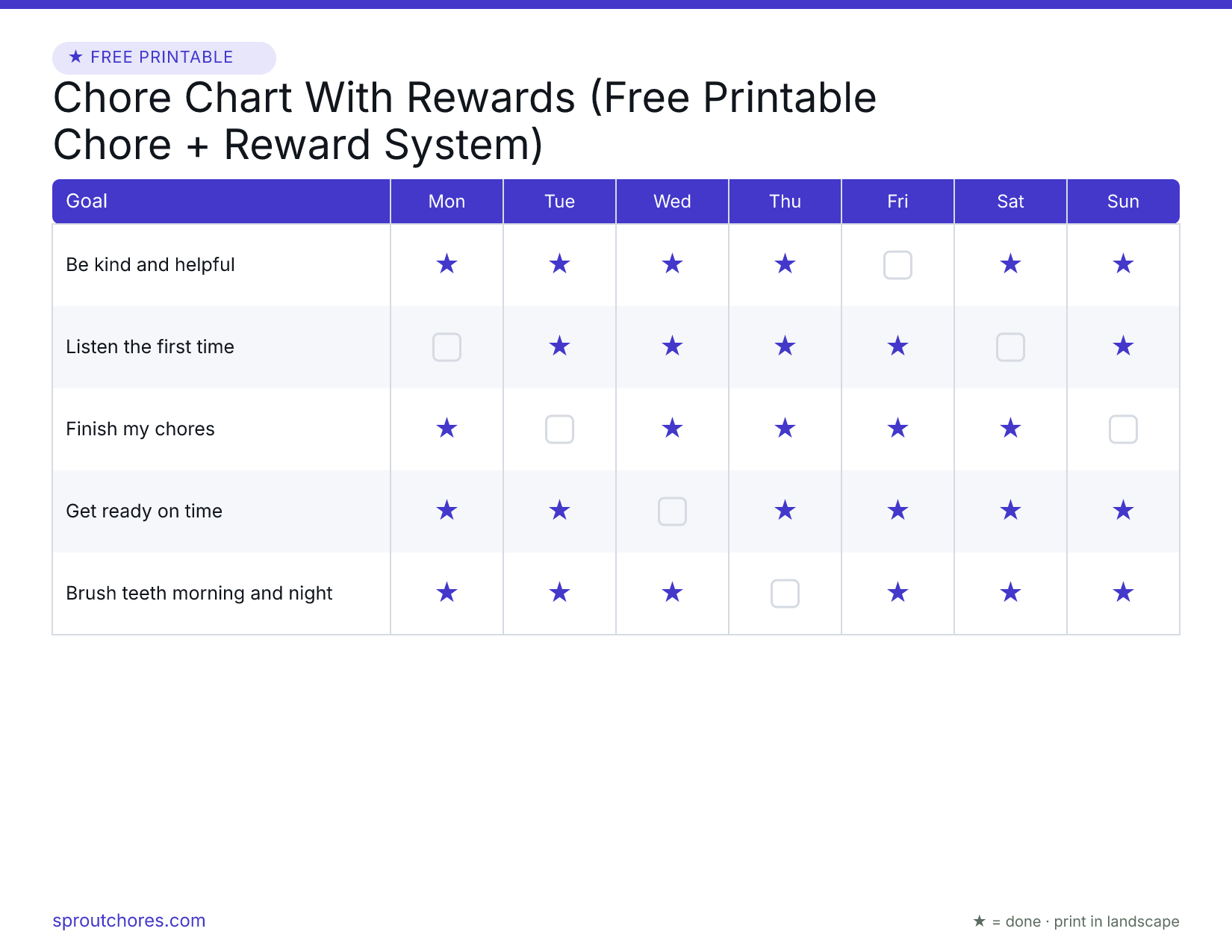
If you came here for a chore chart with rewards, you want something specific: a chart where the jobs run down one side, the week runs across the top, and there's a star to color in for each one done, with a reward waiting at the end. The editable generator on this page builds exactly that. Type in your own goals, switch on the optional reward track, print it for the fridge, and your child can watch the stars stack up toward whatever you've agreed on. Before you fill it in, I'd like to be straight with you about how this actually plays out, because I'm a little allergic to the usual chart advice. I'm Andrew, dad to four kids between 9 and 18, and my wife and I are foster parents too. We've run charts like this for years, and here's the honest version: the stars don't really motivate the kid. The chart is mostly a tool for us, the parents, to see at a glance how each one is doing across a week. The pull to pitch in comes from something quieter than a prize, the plain fact that everyone in this house carries part of the load. That doesn't mean a reward chart is useless. Used as a short-term nudge, kept apart from the everyday stuff that's simply expected, it can give a new habit the push it needs to take hold. The sections below cover how to do that well, how to pick rewards that help instead of hook, and how to ease the chart back out once the habit can stand on its own.
| Goal | Mon | Tue | Wed | Thu | Fri | Sat | Sun | Remove |
|---|---|---|---|---|---|---|---|---|
| Be kind and helpful | ||||||||
| Listen the first time | ||||||||
| Finish my chores | ||||||||
| Get ready on time | ||||||||
| Brush teeth morning and night |
Tip: choose Landscape in the print dialog for the best fit.
Print in landscape for the best fit. A few reminders from our family to yours: do it together the first few times, keep the chart somewhere everyone can see it, and reward steady effort over a perfect job. — The SproutChores family
Want every age in one file? Get the free Age-by-Age Pack
Six printable charts (ages 4–10) plus reward and routine sheets, in one tidy PDF — free, straight to your inbox.
We email you new printables now and then — unsubscribe anytime. Privacy.
Something went wrong — please try again in a moment.
✓ Almost there — check your inbox!
We just emailed you a confirmation link. Click it to confirm, and your free Age-by-Age Chore Chart Pack lands in your inbox moments later.
How to use a reward chart as a short-term boost, not a payment plan
Think of the reward track as training wheels for one specific habit, not as the engine that keeps your child moving. The trick is to point it at something narrow and new, getting out the door without a meltdown, remembering to feed the dog, finishing a bedtime sequence in order, rather than bolting a prize onto the whole pile of things they're already expected to do. When a reward sits on top of a chore that was always going to happen anyway, you've quietly taught your child to expect a payout for ordinary belonging, and that's a tough lesson to walk back. So I'd draw a hard line down the middle of the chart. The everyday family jobs, your own room, your own dishes, the pet you wanted, stay on the plain side with no star attached, because nobody in our house gets a prize for those any more than my wife or I get one for cooking dinner. The reward track is reserved for the one or two things you're genuinely trying to build right now. A few habits have kept this from drifting on us. Mark the chart in the moment the thing happens instead of reconstructing the week later, because the feedback only works when it lands close to the action. Resist erasing a star after a bad afternoon; a chart that can run backward starts to feel like a punishment, and kids quietly stop trusting it. And keep this lane walled off from screen time and from discipline, which run on their own logic. We don't make our kids earn screens through chores, and we don't strip a reward as a penalty for something unrelated. When the chart stays a clean record of one habit you're coaching, it does its job. When it becomes a bargaining table, it teaches negotiation instead of follow-through. One more thing worth saying plainly: not every kid even registers a chart. Our 11-year-old lights up at the idea, she'll happily design her own and chase the stars. Her 9-year-old brother could not care less about it; for him the chart is purely something we read, while the actual nudging happens in real time, a heads-up that the dishwasher's coming in ten minutes, then the cue when it's time. Same house, opposite wiring. Build the chart, but watch which kid it's actually reaching, and don't force the reward column on the one it slides right past.
Choosing rewards that help instead of hook
The reward you pick matters more than the chart design, and the cheapest options have aged the best in our house. For years the workhorse was a little treasure chest from the dollar store. When a stretch of work was done well and with a decent attitude, a younger kid got to pick something out of it, maybe once or twice a week. Because the contents cost next to nothing, we never had to ration it or turn it into a high-stakes negotiation, and the kids still loved the picking. That's the sweet spot I'd aim you toward: small, frequent, low-drama, and easy to give without flinching. The moment a reward gets expensive, you've handed your child a bargaining chip and handed yourself a problem, because now the stakes are high enough to argue over and you'll be tempted to either inflate the prize or quietly back out of it. A few guidelines that have held up. Lean toward experiences and choices over big-ticket objects, an extra story at bedtime, getting to pick the movie on movie night, a small outing, since those build connection rather than a collection. Keep the reward proportional to the effort, not to your guilt about saying no during the week. And remember that for some kids the most reliably motivating thing isn't on the chart at all. Our younger two genuinely respond to a modest weekly allowance, some of which they blow on candy or a dollar-store haul they're weirdly proud of. But even that money isn't paid out a star at a time. It rides on how the whole week went, the quality of the work, whether they stayed on track without me hovering, the attitude they brought, more a reflection of the bigger picture than a per-task fee. That distinction is the whole ballgame. A reward your child earns for genuinely showing up across a week teaches something. A reward dispensed mechanically for each box ticked just teaches them to tick boxes.
When and how to phase the reward chart out
A reward chart is scaffolding. It's supposed to come down once the habit underneath can hold its own weight. The signal is usually a quiet one: the behavior has gone automatic, your child stops checking the chart, and the star has clearly become an afterthought. When a habit no longer needs the prize, the prize has done its work and you can let it fade. You don't need an announcement. We tend to just stop emphasizing the reward on a given habit once it's reliable, then eventually let that row drop off entirely, freeing up space for whatever's still a work in progress. Wean the reward before you retire the whole chart, so the habit gets a chance to stand on its own before the tracking disappears too. A couple of cautions from real life. Don't yank the reward the instant one good week appears, give the habit time to actually set. And don't read the inevitable rough patch, a holiday, an illness, a chaotic stretch where the chart falls off the fridge entirely, as proof the system failed. The systems that survive in real homes aren't the flawless ones; they're the ones you can dust off and restart in five minutes after life knocks them over. Here's the deeper reason I'd nudge you to let rewards fade rather than lean on them forever. Lasting motivation never really came from the prize in our experience, it came from a child feeling like a needed part of something. We saw this most starkly while fostering. When we took in young children who'd known almost no predictable rhythm, what first looked like defiance was usually a kid who simply didn't know what was coming next. A steady, repeated routine settled them far more than any reward ever could, because what they actually needed was to feel safe and to feel like they belonged. No star chart delivers that. The chart can carry a habit for a season, but the thing that makes it stick is the same thing your child is really after, the sense of being part of a family that counts on them. Once they have that, the chart has quietly worked itself out of a job, which was the point all along.
Frequently asked questions
- Do reward charts actually work for kids?
- They can, but probably not the way the marketing suggests. In our experience the stars themselves don't create lasting motivation; they give a brand-new habit a short-term push while it's forming. Used that way, pointed at one or two specific things and kept apart from the chores that are simply expected, a reward chart can genuinely help a habit take hold. But it's worth being realistic that it works far better as a tracking tool for you, the parent, to see how each kid is doing across a week than as a motivation engine for the child. The deeper pull to contribute comes from a child feeling like a needed part of the family, not from a prize. And some kids barely notice a chart at all, which is fine, you meet each one where they are rather than forcing the chart on a kid it isn't reaching.
- What's a good reward for a chore chart?
- Small, frequent, and low-drama beats big and expensive every time. For years our go-to was a dollar-store treasure chest a younger kid could pick from once or twice a week when the work was done well and with a good attitude, cheap enough that we never had to ration it or argue over it. Experiences and choices, an extra bedtime story, picking the movie, a little outing, tend to build connection better than another toy that ends up in a drawer. Keep the reward proportional to the effort and resist letting the stakes climb, because the moment a prize gets pricey it becomes something to negotiate over. And keep it separate from screen time and from punishment, which run on their own logic.
- Should I reward my child for every chore?
- We don't, and I'd gently suggest you don't either. The everyday jobs, your own room, your own dishes, caring for the family pet, belong to everyone living under the roof and stay unrewarded, the same way the adults aren't paid or prized for making dinner. Reserve the reward track for one or two habits you're actively trying to build right now. Rewarding everything quietly teaches a child to expect a payout for ordinary belonging, and they start negotiating before they'll lift a finger. If you do tie money in, like the modest weekly allowance our younger kids earn, base it on how the whole week went, the quality, the consistency, the attitude, rather than handing out a set amount per task.
- When should I stop using a reward chart?
- Start phasing it out once the habit has gone automatic and your child stops paying attention to the chart, that fading interest usually means the habit has stuck, which was the goal. Wean the reward off a given habit before you retire the whole chart, so it gets a chance to stand on its own. There's no need for a ceremony; just let that row quietly drop off and reuse the space for something still in progress. Don't pull it after a single good week, and don't treat a holiday or a chaotic stretch as failure, the best systems are simply easy to restart. Letting rewards fade on purpose nudges your child toward the motivation that actually lasts, the feeling of being a contributing part of the household.

About the author
More free printables
Get the free Age-by-Age Chore Chart Pack
Six printable charts (ages 4–10) plus reward and routine sheets, in one tidy PDF. We'll also send new printables and the occasional real parenting tip. The charts on this site are always free — no sign-up needed.
We email you new printables now and then — unsubscribe anytime. Privacy.
Something went wrong — please try again in a moment.
✓ Almost there — check your inbox!
We just emailed you a confirmation link. Click it to confirm, and your free Age-by-Age Chore Chart Pack lands in your inbox moments later.