Star Chart for Kids (Free Printable Star Reward Chart)
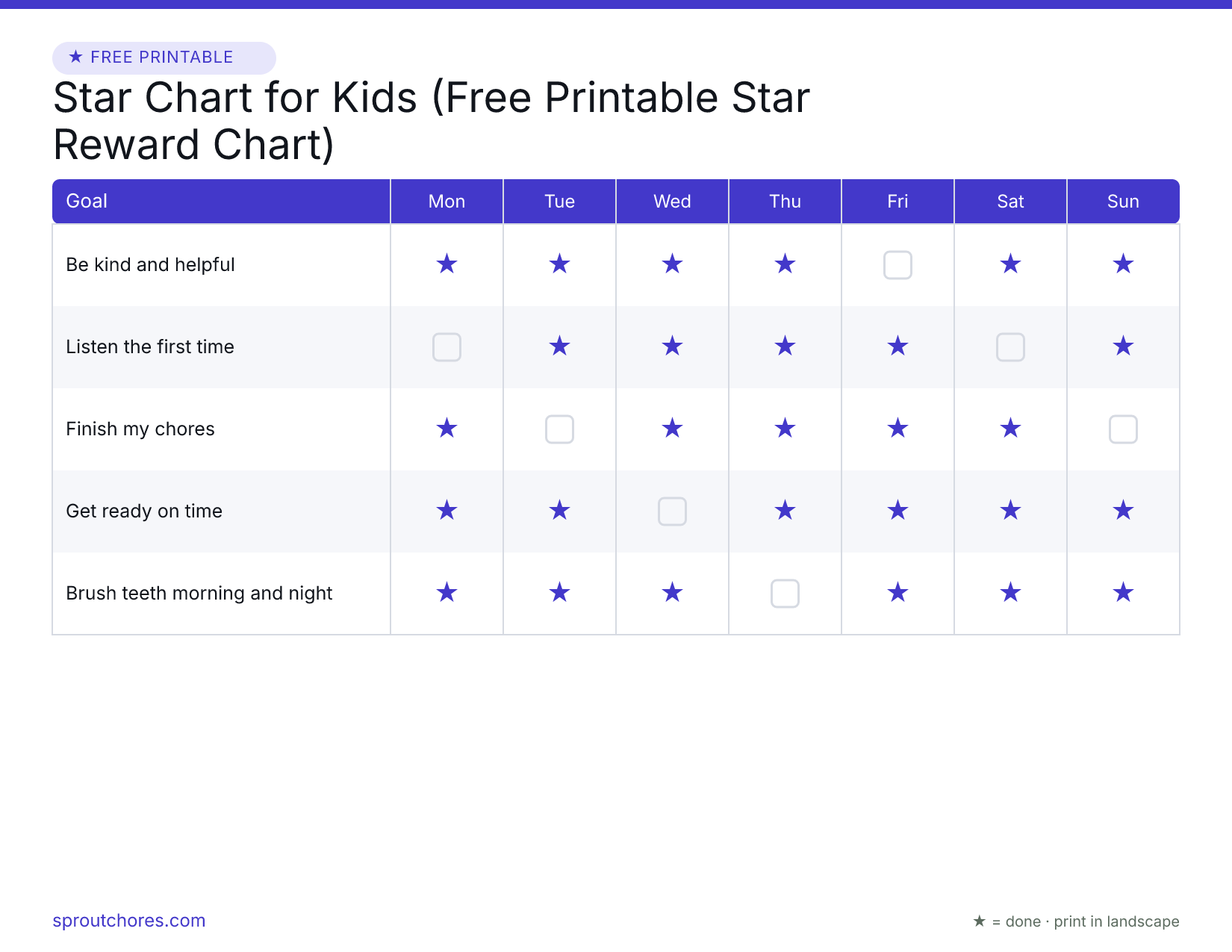
A star chart is the same friendly idea as a sticker chart, just with a star to color in, stamp, or check off each time your child hits their goal — and for a lot of little kids, that empty star waiting to be filled is oddly powerful. The chart on this page is editable, so you type in what you're working on, keep the days of the week running across the top, and print it for the fridge or a bedroom door. Our best advice up front: aim it at one habit, and let a single star a day be the whole game. A quick note on who's talking. We're the SproutChores family — I'm Andrew, and between my wife and me we're raising four kids from 9 to 18, and we've fostered younger ones along the way. We've leaned on charts like this at every age, and the thing we most want you to know is that a star chart earns its keep as a way for you to see how the week is going, not as a machine for bribing a child into good behavior. Kids rise to a home where they're genuinely counted on; the star is just a bit of momentum while a new habit finds its feet. Set yours up below, then read on for how we keep it working.
| Goal | Mon | Tue | Wed | Thu | Fri | Sat | Sun | Remove |
|---|---|---|---|---|---|---|---|---|
| Be kind and helpful | ||||||||
| Listen the first time | ||||||||
| Finish my chores | ||||||||
| Get ready on time | ||||||||
| Brush teeth morning and night |
Tip: choose Landscape in the print dialog for the best fit.
Print in landscape for the best fit. A few reminders from our family to yours: do it together the first few times, keep the chart somewhere everyone can see it, and reward steady effort over a perfect job. — The SproutChores family
Want every age in one file? Get the free Age-by-Age Pack
Six printable charts (ages 4–10) plus reward and routine sheets, in one tidy PDF — free, straight to your inbox.
We email you new printables now and then — unsubscribe anytime. Privacy.
Something went wrong — please try again in a moment.
✓ Almost there — check your inbox!
We just emailed you a confirmation link. Click it to confirm, and your free Age-by-Age Chore Chart Pack lands in your inbox moments later.
How to set up a star chart that sticks
The temptation with any blank chart is to fill it with everything you wish your child would do. Resist it — especially at first. A star chart does its best work pointed at a single habit, with one star to earn each day. Maybe it's staying in their own bed until morning, getting dressed without a standoff, or feeding the dog before school. Pick the one thing that would make your days noticeably smoother, and leave the rest off. One clear target is something a three- or four-year-old can actually hold in their head; a chart bristling with demands just becomes wallpaper everyone stops seeing.
Hang it where your child's eyes already go — low on the fridge, beside the bathroom light switch, on the door they push open every morning. Out of sight really is out of mind at this age. Say the goal in words so plain there's nothing to negotiate: "shoes on before we leave" beats "be ready," which a determined kid can define however suits them.
Two small habits of our own have saved us more friction than any reward. The first is a warning shot before the moment lands — letting a child know a few minutes ahead that the thing is coming, rather than issuing it cold, heads off most of the digging-in. The second is a rule we never break: we don't erase a star once it's earned. The day it becomes possible to lose stars is the day the chart starts to feel like a trap, and kids quietly stop believing in it. Let it keep the wins, and handle the rough patches with a conversation rather than by docking the board. And if a busy week blows the whole thing up — it will, eventually — just start again. The systems that last aren't the flawless ones; they're the ones easy enough to restart on a Monday after life has knocked them over.
Choosing a reward without turning stars into a paycheck
Think of the reward as a little spark at the finish line, not wages and not the reason your kid cooperates. What worked cheapest and best for us was a small grab-bag of inexpensive odds and ends; when one of the kids had put in honest effort over a stretch, they got to reach in and choose something. Because none of it cost much, we never felt the need to ration it, and the kids treated a pick as a genuine treat rather than a payment they were owed.
A few lines we draw on purpose. We keep screens and ordinary fun off the chart — the minute those turn into things a child buys with good behavior, everyday family life starts to feel like a running tab, and that's a hard habit to reverse later. We also keep the star chart well clear of the regular jobs everyone in the house does simply because they live here. In our home, chores aren't a paid service; they're practice for growing into a capable adult, and they belong to all of us together. That's exactly why a star chart works best on one fresh habit rather than on the daily contributions we already expect — it keeps a short-term nudge from quietly rewriting the deal on things that should never have needed a prize. If we attach any money at all, it comes later, as an allowance tied to how a child is doing over the long run — their reliability, their effort, the attitude they bring — never counted out star by star.
Star charts for toddlers, big kids, and specific behaviors
"Kids" covers a lot of ground, and a star chart means something different at each end of it. For toddlers and threes, the chart is really about rhythm and repetition — self-care things like getting dressed, tidying their own mess, or brushing without a fuss. Don't expect polish; you'll redo plenty of it yourself, and that's not the chart failing. At this stage you're laying down muscle memory, and the star simply marks that the routine happened. By six through nine, the same chart shifts toward follow-through — doing the thing without a reminder — and kids this age can feel real pride in a full week of stars.
If you're reaching for a star chart to work on behavior rather than a task, the single-habit rule matters even more. Trying to fix everything at once overwhelms a young child; picking one behavior — speaking kindly to a sibling, using words instead of yelling when frustrated, staying at the table through dinner — gives them something specific and reachable to aim at.
The biggest thing we've learned is that the same chart can be magic for one child and invisible to another under the same roof. Our 11-year-old lights up designing her own chart and following it to the letter; she's wired for exactly this. Our youngest, at that age, genuinely couldn't have cared less about a chart — for him, a steady routine and a real-time nudge did all the work a chart was meant to. Neither kid was doing it wrong. If a star chart clicks for your child, wonderful; if it doesn't, that's useful information too, and it just means the tool that fits them is a different one.
The real job of the chart, and when to put it away
Here's the part most star-chart advice skips: the chart isn't really there to motivate your child. It's there to inform you. A glance down a week of stars tells you which habit is taking hold and which one is quietly slipping, so you can lean in or ease off without a single nag. Read it as your own instrument panel rather than a score your child is racking up.
That same read tells you when you're done. Once a habit runs on its own — the child does it without thinking, without the star — you can simply stop tracking it. No ceremony needed; retire that goal and, if you like, aim a fresh star at whatever's still wobbly. And don't judge progress day to day, because real change in a kid is almost impossible to see up close. You notice it only in the rear-view mirror: the thing that took three reminders last spring now just happens on its own. That kind of shift never arrives in one triumphant week of stars; it grows out of months of the same calm expectation.
We saw the quiet power of that predictability most clearly while fostering. Children who'd known little steadiness before came to us needing a dependable daily rhythm far more than they needed any prize — knowing what came next was what let them settle and begin to trust us. Behavior that reads as stubbornness is often just a child who isn't sure what's coming next, and a routine they can count on answers that in a way a reward never could. A star chart, at its best, is a small piece of that same steadiness: proof, one filled star at a time, that this is a home where things are predictable and everyone has a part to play.
Frequently asked questions
- What's the difference between a star chart and a sticker chart?
- Honestly, not much — they're the same reward-chart idea wearing different clothes. On a sticker chart your child sticks on a physical sticker; on a star chart they color in, stamp, or check off a drawn star. Some kids are more motivated by peeling and placing a real sticker, others love filling in a star themselves, and plenty don't notice the difference at all. Pick whichever your child finds satisfying — the mechanics that matter are the same: one clear goal, one mark earned per day, and a small treat waiting at the end of a good run.
- How many stars should my child earn before a reward?
- There's no magic number, but we'd lean toward fewer stars than you might expect, and a reward that stays small. For a young child, a week of daily stars — five to seven — is plenty to feel like an accomplishment; stretch it much longer and a preschooler loses the thread. More important than the count is keeping the reward modest and occasional rather than a guaranteed payout for every filled box. A little treat earned by a solid stretch of effort keeps its shine, while a prize owed for each individual star quickly turns cooperation into a transaction.
- What age is a star chart best for, and does it work for toddlers?
- Star charts land best from around age three through eight or nine. With toddlers they can absolutely help, but think of the chart as a routine cue more than a motivator — it marks that a step of the day happened, and you'll still be doing much of the work alongside them. That's normal at that age; you're building a habit, not collecting results. Older kids in the single digits get more out of it, taking real pride in a full week and needing fewer reminders. If you're using one to work on behavior, the same rule holds: aim at a single behavior at a time rather than a long list, so it stays something your child can actually reach.

About the author
More free printables
Get the free Age-by-Age Chore Chart Pack
Six printable charts (ages 4–10) plus reward and routine sheets, in one tidy PDF. We'll also send new printables and the occasional real parenting tip. The charts on this site are always free — no sign-up needed.
We email you new printables now and then — unsubscribe anytime. Privacy.
Something went wrong — please try again in a moment.
✓ Almost there — check your inbox!
We just emailed you a confirmation link. Click it to confirm, and your free Age-by-Age Chore Chart Pack lands in your inbox moments later.