Reward Charts for Kids (Free Printable Star & Sticker Charts)
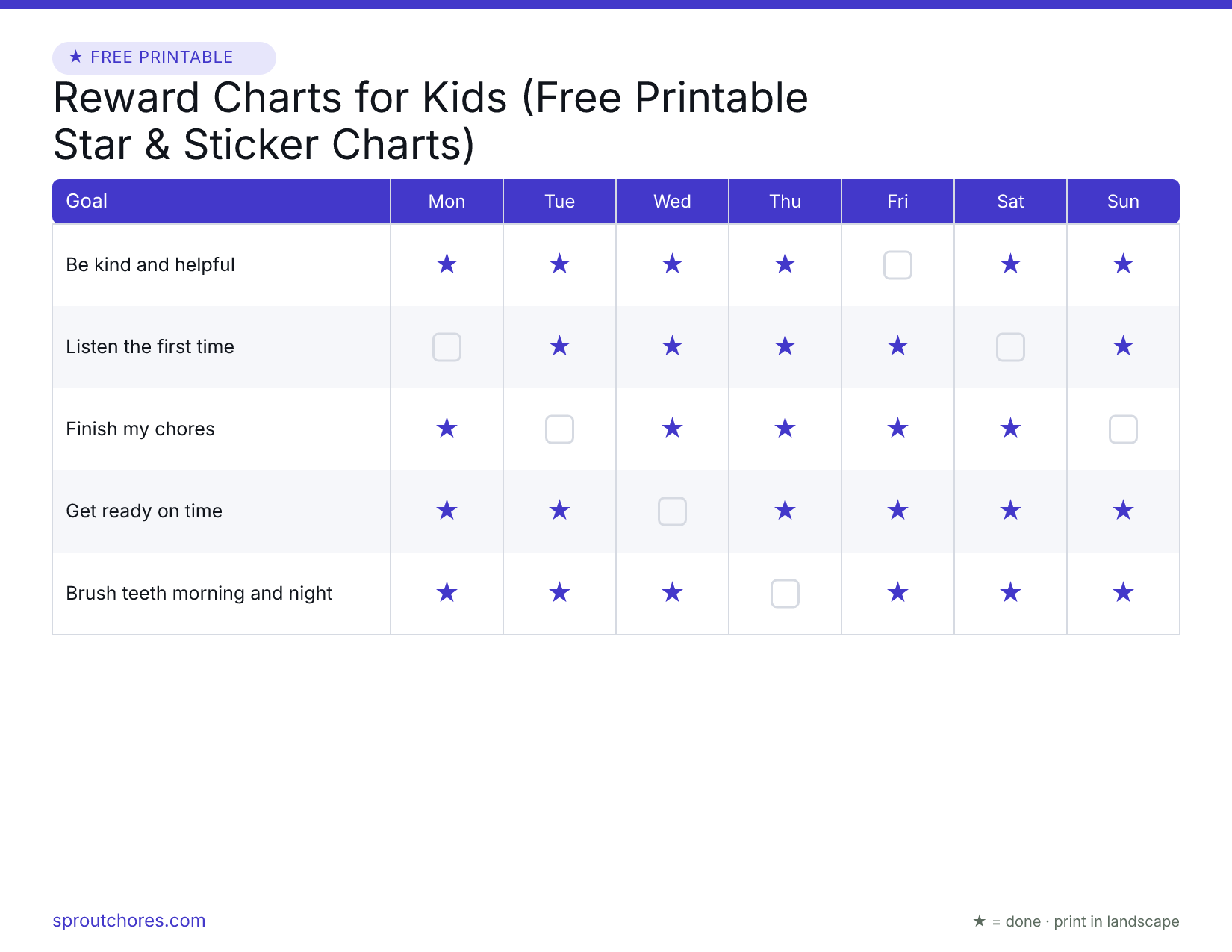
There's a reason reward charts have stuck around for generations: a goal, a tidy row of empty boxes, and a sticker waiting to land in each one is irresistible to a small kid. The chart on this page is editable, so you set the goals running down the side and the days across the top, then print it for the fridge, a bedroom wall, or a clipboard by the door. You get to decide what earns a star and what a full row is worth. Before you build yours, one bit of honesty from our family. We're the SproutChores household — Andrew, my wife, and four kids between 9 and 18, plus the children we've fostered over the years — and we've used charts like this through every stage of raising them. What we keep coming back to is this: a reward chart is at its best as a window, not a wallet. It lets you see how a kid is doing across a week, and it gives a little one something fun to aim at — but the deeper reason children rise to the occasion isn't the prize. It's growing up in a home where everyone has a part to play. Hold the chart loosely with that in mind and it'll serve you well. Build yours below, then read on for how we keep it useful.
| Goal | Mon | Tue | Wed | Thu | Fri | Sat | Sun | Remove |
|---|---|---|---|---|---|---|---|---|
| Be kind and helpful | ||||||||
| Listen the first time | ||||||||
| Finish my chores | ||||||||
| Get ready on time | ||||||||
| Brush teeth morning and night |
Tip: choose Landscape in the print dialog for the best fit.
Print in landscape for the best fit. A few reminders from our family to yours: do it together the first few times, keep the chart somewhere everyone can see it, and reward steady effort over a perfect job. — The SproutChores family
Want every age in one file? Get the free Age-by-Age Pack
Six printable charts (ages 4–10) plus reward and routine sheets, in one tidy PDF — free, straight to your inbox.
We email you new printables now and then — unsubscribe anytime. Privacy.
Something went wrong — please try again in a moment.
✓ Almost there — check your inbox!
We just emailed you a confirmation link. Click it to confirm, and your free Age-by-Age Chore Chart Pack lands in your inbox moments later.
Setting up a reward chart that actually gets used
The first decision matters more than people expect: where the chart lives. Put it somewhere your child's eyes naturally fall — down at their height on the fridge, taped to the wall they pass on the way to bed — not filed away where only you'll remember it. With younger kids, that placement is doing real work. We learned how much when one of the children we fostered was small; little picture reminders posted right where each step happened, in the room where it happened, told a child what came next without anyone having to repeat themselves. A chart in plain sight works the same quiet way. Keep the list short. Two or three goals is plenty for a preschooler, and you can stretch it as they grow more capable; a chart crowded with demands gets ignored by everyone, the parents included. Spell each goal out so plainly there's nothing to argue about — "clothes on before breakfast" leaves no wiggle room the way "get ready" does. And here's a lever that's saved us more standoffs than any sticker ever did: give a heads-up before the moment arrives. "In a little while we're going to fill in your chart for getting dressed" lands far softer than springing it on a child mid-play. One thing to avoid outright — don't take stars back after a bad afternoon. A chart that can run in reverse starts to feel like a trap, and kids stop trusting it. Let it hold the good days, and deal with the hard ones face to face.
Picking rewards that boost without backfiring
Treat the reward as a small jolt of fun at the finish line, not a salary and not the reason your child shows up. Honestly, the version that worked best in our house was almost comically cheap. We kept a little stash of dollar-store odds and ends, and a kid who'd put in good effort with a good attitude got to pick something from it once or twice a week. Because nothing in there cost much, we never had to ration it or feel pinched, and the kids treated each pick as a real treat rather than a debt we owed them. A few things we'd keep off the chart on purpose. We don't tie screen time or ordinary fun to filled-in boxes — once those become the currency, regular family life starts to feel like a series of transactions, and that's hard to unwind later. (Screens are their own conversation in our home; we limit them to protect sleep and focus, not as a prize to be bought.) We'd also keep the reward chart clear of the everyday jobs kids do simply because they belong to the family. Those tasks aren't for sale — they're how we all carry the household together — and aiming the chart at a single new habit instead, like a smoother bedtime or remembering to brush unprompted, keeps the two from getting tangled. The truth we've watched play out over years is that the prize was never what made the difference. The lasting motivation grew from kids feeling genuinely needed at home, with the chart just helping a new habit take root.
What the chart is really for, and when to let it go
Here's the reframe most chart guides skip. The chart isn't there to motivate your child — it's a tracking tool for you. A glance across a week of stars tells you which kid is sailing through, which one is quietly losing the morning battle, and where you might step in or back off, all without a single nag. Picture it as your dashboard, not their scoreboard. That same lens tells you when the chart has finished its job. As a habit turns automatic, you can quietly stop tracking it — no announcement required; just let that goal drift off and hand the row to whatever's still a work in progress. Expect the timing to swing wildly with age. With toddlers the chart is really about routine and repetition, and you'll redo plenty of the work yourself — that's normal, you're building muscle memory, not results. Through the older single digits it shifts toward steady follow-through rather than reminders. By the teen years a fridge chart mostly stops working, in our experience; older kids respond to clear, grown-up agreements far more than to stickers. And don't measure any of this day to day. Real change in a child is nearly invisible up close — you only notice it looking back. Our youngest now gathers every bag of trash in the house entirely on his own, and that didn't arrive in one proud week of stars; it grew out of years of the same calm expectations. We saw the power of structure most clearly while fostering: children who'd known little predictability needed a reliable rhythm far more than they needed prizes. What first looked like acting out was often just a kid unsure of what came next, and a steady routine settled them in a way no reward could — because what they truly needed was to feel safe and to belong. That's the same thing your chart is quietly building toward.
Frequently asked questions
- What age are reward charts for kids best for?
- They shine with toddlers up through roughly age eight or nine, when landing a star is genuinely thrilling and the chart doubles as a visual cue for the daily routine. With the youngest kids, expect it to be more about building a habit than producing tidy results — you'll still redo a lot of the work, and that's fine. Older kids and teens tend to tune out a sticker chart entirely; for them, clear expectations and more grown-up arrangements do far more than a chart on the fridge ever will.
- Should I pay my child or give a prize for every star?
- We'd steer clear of paying out star by star — it quickly turns cooperation into a transaction, and the prize becomes the whole point. A reward chart works better when the treat is small, occasional, and earned by a good stretch of effort and attitude rather than counted per box. Keep it separate from the everyday jobs kids do as part of the family, and keep screens and money on their own tracks. If you do attach any allowance, base it on overall consistency and attitude over time, not on tallying individual tasks.
- My child stopped caring about the reward chart. Did it fail?
- Usually the opposite. Fading interest most often means the habit has become automatic — which was the goal — so it's a fine cue to quietly retire the chart for that goal and aim it at something new. Remember its real job was helping you track how things were going, not supplying day-to-day motivation. Lasting cooperation comes from a child feeling like a needed part of the household, so it's perfectly healthy for the stickers to lose their shine once the habit has set.
- How do I get a free printable reward chart?
- Use the editable chart on this page: type your goals down the side, keep the days of the week across the top, and print it at home for the fridge or a bedroom wall. There's no signup and nothing to pay. Start with just two or three goals for a younger child so the chart feels achievable rather than overwhelming, and add more rows later as new habits are ready to work on.

About the author
More free printables
Get the free Age-by-Age Chore Chart Pack
Six printable charts (ages 4–10) plus reward and routine sheets, in one tidy PDF. We'll also send new printables and the occasional real parenting tip. The charts on this site are always free — no sign-up needed.
We email you new printables now and then — unsubscribe anytime. Privacy.
Something went wrong — please try again in a moment.
✓ Almost there — check your inbox!
We just emailed you a confirmation link. Click it to confirm, and your free Age-by-Age Chore Chart Pack lands in your inbox moments later.