Chore Wheel
A chore wheel is two discs that turn against each other: names on one ring, jobs on the other, and a small spin each week to reassign everything. It solves the one complaint every shared home eventually hears — that someone always gets the worst job. When the wheel does the assigning, the dish duty and the bathroom and the trash move from person to person on their own, so no single body is permanently stuck with the thing nobody wants. Use the maker below to build yours: type in everyone who lives here, list the jobs your home actually needs, and the wheel pairs them up — then print it, mount it somewhere you all pass, and give it a turn every week. I'm Andrew, and I write here as a dad of four who, with my wife, has also fostered kids over the years. The rule our whole house runs on is plain — everyone under this roof helps keep it standing — and that holds just as well for roommates or a couple as it does for a family with young kids. A wheel is simply a friendlier-looking way to make that fair and keep it that way.
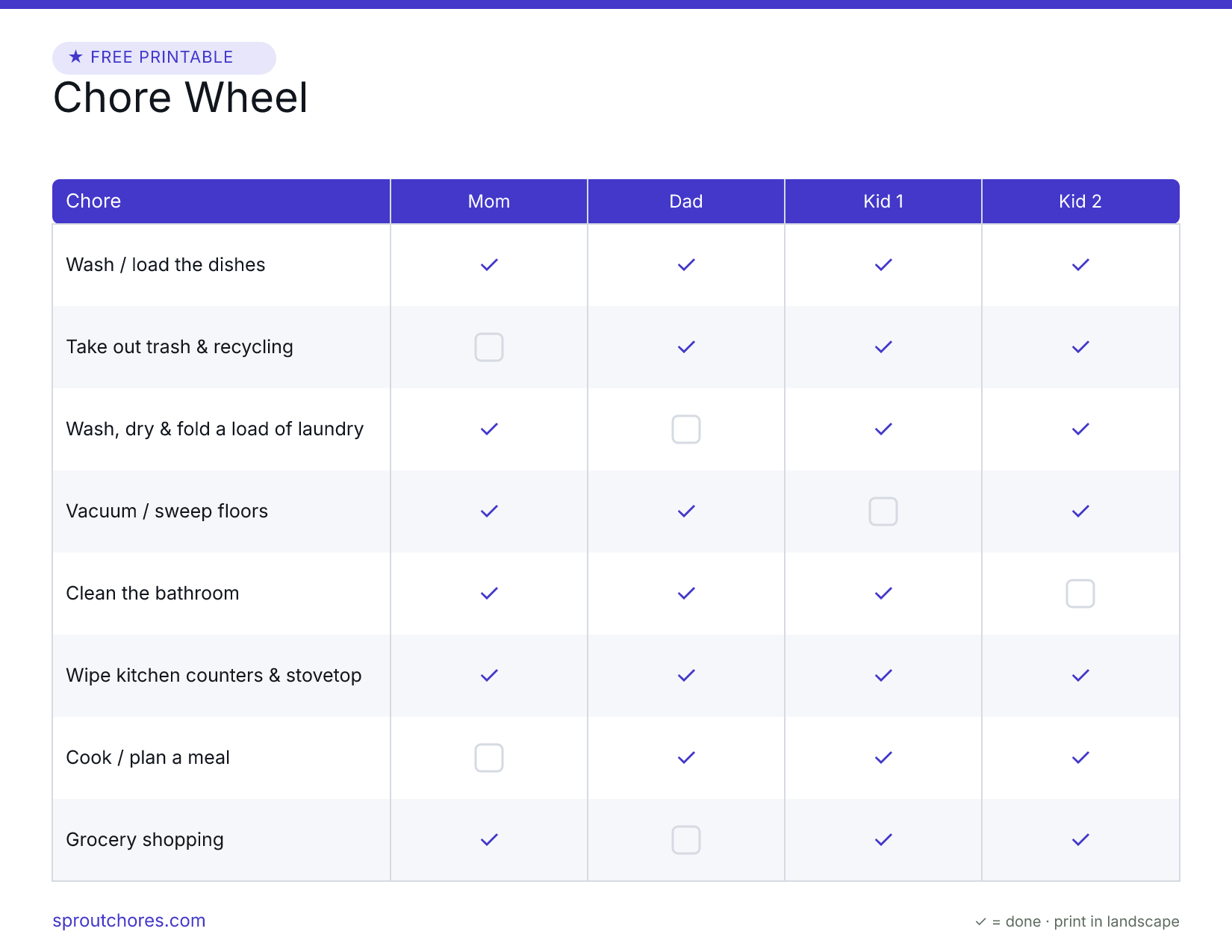
| Chore | Mom | Dad | Kid 1 | Kid 2 | Remove |
|---|---|---|---|---|---|
| Wash / load the dishes | |||||
| Take out trash & recycling | |||||
| Wash, dry & fold a load of laundry | |||||
| Vacuum / sweep floors | |||||
| Clean the bathroom | |||||
| Wipe kitchen counters & stovetop | |||||
| Cook / plan a meal | |||||
| Grocery shopping | |||||
| Tidy shared living areas | |||||
| Change bed linens |
Tip: choose Landscape in the print dialog for the best fit.
Print in landscape for the best fit. A few reminders from our family to yours: do it together the first few times, keep the chart somewhere everyone can see it, and reward steady effort over a perfect job. — The SproutChores family
Want every age in one file? Get the free Age-by-Age Pack
Six printable charts (ages 4–10) plus reward and routine sheets, in one tidy PDF — free, straight to your inbox.
We email you new printables now and then — unsubscribe anytime. Privacy.
Something went wrong — please try again in a moment.
✓ Almost there — check your inbox!
We just emailed you a confirmation link. Click it to confirm, and your free Age-by-Age Chore Chart Pack lands in your inbox moments later.
Why a rotating wheel beats a fixed grid
A normal chore grid freezes the assignments in place. Whoever drew the unpopular job in week one tends to keep it, week after week, and resentment builds quietly until someone snaps. A wheel breaks that by design — the jobs move, so an unpleasant task is never anyone's forever. It's the same task list a grid would hold, just on a format that takes turns.
There's a second thing a wheel does that a grid can't: it makes the rotation feel decided by the system rather than by a person. That distinction matters more than it sounds. In our house I learned early that handing someone a job out of nowhere lands like an order, and people of every age dig in against orders — kids and grown adults alike. A wheel sidesteps that entirely, because nobody assigned you the bathroom this week; the wheel landed there. The job stops being something you can argue with a person about and just becomes this week's turn.
It also reads well to younger kids who don't track lists yet. A spinning thing with their name on it is concrete in a way a column of text never is — they can see, physically, that the job came around to them. One of mine has always loved anything she can build and run herself; a wheel she gets to turn each week is exactly the kind of small ritual a kid like that will actually look forward to, which is more than I can say for most charts.
Dividing the load so it lands fairly
Fair almost never means everyone doing the exact same amount on the exact same day — chasing a perfectly even count is how a shared home ends up keeping score. What fair really means is that, over a few turns of the wheel, the heavy and the light jobs spread across everyone, so no one's looking at their week and thinking they got robbed.
The first move is to get every job onto the wheel, including the invisible ones. A lot of friction in any home comes from work one person silently absorbs because it never made it onto a list — wiping the counter nobody else notices, restocking what runs out, taking the trash before it overflows. Put all of it on the outer ring. Once it's written down and spinning with everyone's name, that quietly-absorbed work becomes shared work, and the conversation changes from a vague sense of imbalance to something you can all point at.
Then size the wheel to who's actually doing it. A house of capable teens and adults can carry a fuller ring of real jobs; a wheel that includes younger kids should give them turns at things they can genuinely manage. The way we frame it for our own kids is that a chore isn't a punishment and it isn't a transaction — nobody gets paid per task here — it's the cost of belonging to a place and choosing to keep it running together. That framing is exactly why a wheel works: it isn't there to bribe anyone into helping. It's there so the helping is fair and visible, and so the agreement about who does what this week lives on the wall instead of in one tired person's head.
Cutting the mental load and the weekly nagging
There's a kind of tiredness that never shows up as a completed task: being the one who has to remember everything. Not the person who empties the dishwasher, but the person who notices it's full, decides it's time, and then has to go ask. That noticing-and-tracking work is the mental load, and when it sits on one person it grinds them down even when the physical jobs look evenly split.
A wheel moves that tracking off a single set of shoulders and onto an object everyone can see. Once the week's pairings are set, there's no manager role left to play — nobody has to ask whether the kitchen got handled, because the wheel already says whose week it was. That one shift erases most of the nagging in a home, since nagging is usually just the tracking person trying to hand off a reminder they're exhausted from carrying.
A habit that's saved us countless standoffs is giving a heads-up before a job is due rather than springing it in the moment. There's a real gap between 'go do the bathroom right now' and 'the bathroom's your turn this week, plan to get to it before the weekend' — the second gives a person room to shift into it, and it heads off a surprising amount of conflict. The wheel does that work for you, since the whole rotation is posted in advance. I'll also be straight about what a wheel is and isn't, because it's the same thing I'd say about any household system: the ones that last are the ones you can drop for a bad week and pick right back up. If yours falls apart the first time someone travels or gets sick and never recovers, that's a design problem, not a character flaw — keep it simple enough to just give it a fresh spin next Monday and carry on.
Making everyone's contribution visible
When work is invisible, people undercount what everyone else does and overcount their own — not out of selfishness, but because you feel your own effort and only ever see the results of theirs. A wheel on the wall fixes the accounting. Every name and every job is right there, turning in plain sight, so each person can actually see what the others are carrying. The resentment that grows in the dark tends to fade once the whole load is out in the open.
Visibility is also what turns a vague 'we all pitch in' into real ownership. A job sitting next to your name on a wheel everyone walks past is yours in a way a good intention never is. That clarity is the entire point — not so anyone can keep a tally, but so nobody's left guessing where their responsibility starts and stops this week.
Fostering taught me how much of what looks like friction in a home is really just uncertainty about what comes next. Kids who'd never had a dependable rhythm settled noticeably once they could predict the shape of their days, and the same principle holds for any house: a system everyone can see removes the guesswork that quietly causes most of the tension. A chore wheel is a tracking tool, not a pressure lever — it's there to make the arrangement obvious and fair, so a shared expectation does the heavy lifting instead of a confrontation. And none of this gets sorted in a heated moment; you can't reason anyone, yourself included, out of a dug-in state. Set the wheel up when everyone's calm, hang it where you'll all see it, and let the format carry the weight that nagging never could.
Frequently asked questions
- How does a chore wheel work?
- A chore wheel is two discs pinned at the center so they spin independently. One disc holds the names of everyone in the home; the other holds the jobs. You line them up to pair each person with a task, and once a week you turn the wheel a notch so the assignments rotate — meaning nobody stays stuck with the same chore for long. The maker above builds yours automatically: add the people who live with you and the jobs your home needs, and it pairs them up. Print it, mount it somewhere everyone passes, and give it a spin on the same day each week so the rotation becomes a small, predictable ritual rather than a debate.
- Is a chore wheel good for adults and roommates, or just kids?
- It works well for both, and for different reasons. With kids, the spinning, visible format lands better than a column of text — especially for younger ones who can't track a list yet but can clearly see the job came around to them. With roommates and partners, the wheel's real value is that it depersonalizes the assignment: nobody handed you the kitchen this week, the rotation did, so the friction of one person seeming to boss the others goes away. For a shared adult home, fill the wheel with specific, real jobs and actual names, and let the weekly turn settle who does what instead of an awkward standing negotiation.
- How often should you rotate a chore wheel?
- Weekly is the sweet spot for most homes. A week is long enough to actually finish a job and short enough that no unpleasant task feels permanent, which is the whole reason to use a wheel instead of a fixed chart. Pick a consistent turn day — many homes use Sunday or Monday — so the reset is predictable and people can mentally prepare for what's landing on them next. If a week ever gets blown up by travel or illness, don't treat it as the system failing; just pick back up and spin again on the next turn day. The easiest wheel to restart is the one that actually lasts.

About the author
More free printables
Get the free Age-by-Age Chore Chart Pack
Six printable charts (ages 4–10) plus reward and routine sheets, in one tidy PDF. We'll also send new printables and the occasional real parenting tip. The charts on this site are always free — no sign-up needed.
We email you new printables now and then — unsubscribe anytime. Privacy.
Something went wrong — please try again in a moment.
✓ Almost there — check your inbox!
We just emailed you a confirmation link. Click it to confirm, and your free Age-by-Age Chore Chart Pack lands in your inbox moments later.