Deep Cleaning Checklist (Free, Printable & Room-by-Room)
There's one kind of cleaning almost nobody keeps up with, and it isn't the dishes. It's the slow, hidden stuff — the dust riding the tops of the door frames, the greasy film behind the stove, the vents you haven't really looked at since you moved in. Your daily and weekly routine keeps the house livable, but it quietly steps around all of that, and it just keeps building. I'm Andrew, a dad of four here at SproutChores, and this deep cleaning checklist is the seasonal counterpart to those everyday routines: a room-by-room list of the jobs that only need doing every few months but genuinely need doing. Build yours in the editable maker above — keep the rooms you have, drop in the jobs that fit your home, and print the whole thing as a PDF for free. Then work through it one room at a time, at whatever pace real life allows. The goal isn't a magazine-perfect house for one exhausting afternoon. It's finally reaching the corners your weekly clean was never meant to touch.
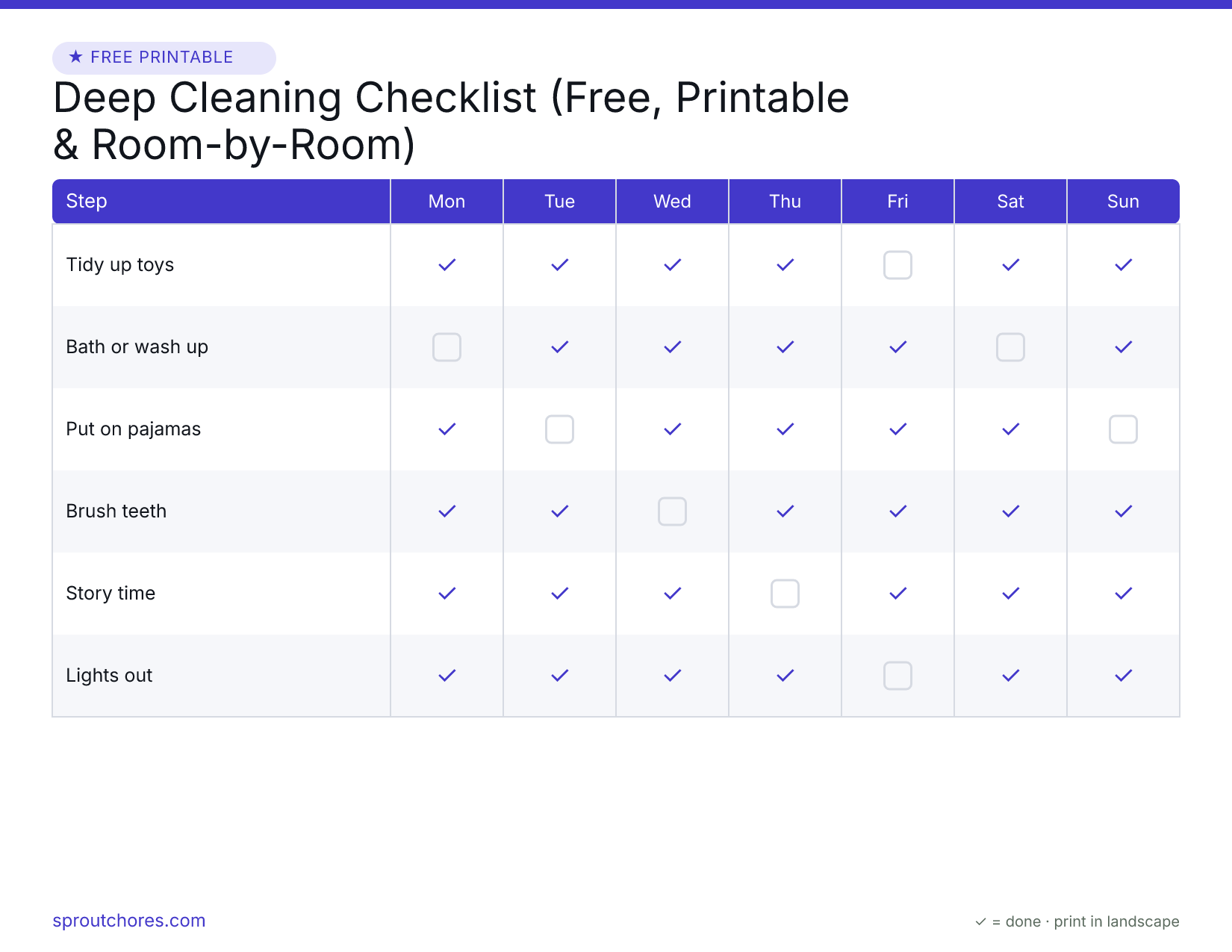
| Step | Mon | Tue | Wed | Thu | Fri | Sat | Sun | Remove |
|---|---|---|---|---|---|---|---|---|
| Tidy up toys | ||||||||
| Bath or wash up | ||||||||
| Put on pajamas | ||||||||
| Brush teeth | ||||||||
| Story time | ||||||||
| Lights out |
Tip: choose Landscape in the print dialog for the best fit.
Print in landscape for the best fit. A few reminders from our family to yours: do it together the first few times, keep the chart somewhere everyone can see it, and reward steady effort over a perfect job. — The SproutChores family
Want every age in one file? Get the free Age-by-Age Pack
Six printable charts (ages 4–10) plus reward and routine sheets, in one tidy PDF — free, straight to your inbox.
We email you new printables now and then — unsubscribe anytime. Privacy.
Something went wrong — please try again in a moment.
✓ Almost there — check your inbox!
We just emailed you a confirmation link. Click it to confirm, and your free Age-by-Age Chore Chart Pack lands in your inbox moments later.
What counts as a deep clean — and what your routine keeps skipping
Regular cleaning and deep cleaning are two different jobs, and blurring them together is a big part of why the deep clean so rarely happens. Your daily reset and weekly pass exist to handle the mess that comes back fast — counters, floors, the bathroom sink, the surfaces that show a day of living. A deep clean is aimed at the opposite kind of dirt: the buildup that accumulates so slowly you stop noticing it. Think baseboards and trim, the range hood and the wall behind the stove, air vents and ceiling-fan blades, the coils and drip pan behind or beneath the fridge, window tracks, light fixtures, grout lines, the inside of the oven, and the floor hiding under beds and heavy furniture.
None of those will wreck your week if you skip them, which is exactly why they get skipped for years. But dust dulls a whole room, greasy residue keeps thickening behind an oven, and a clogged dryer vent is a real fire hazard — so the jobs your routine walks past are worth catching up on a few times a year. For most homes that means a proper deep clean roughly once a quarter or with the change of seasons, with a handful of the heaviest jobs — washing walls, flipping the mattress, pulling out the big appliances — landing closer to once or twice annually. Let how hard a room actually gets used set the pace: a kitchen earns a deep clean far more often than a spare bedroom nobody sleeps in.
How to deep clean a whole house without losing a weekend
The single biggest reason a deep clean never happens is that people picture the entire house at once — a lost Saturday, every room, top to bottom — and the mind quietly files that under "not today." I know that reflex intimately. A task that stretches across a whole day or a whole week reads to my brain as "don't even start," and I'll suddenly find ten smaller, easier things to do instead. The way I get past it, at work and at home, is to stop treating the deep clean as one enormous job and start treating it as a stack of small, finishable ones.
So don't put "deep clean the house" on the calendar. Pick one room. Better yet, pick one job in one room — the oven today, the living-room baseboards tomorrow — and let finishing that be the entire win. When a single room is scrubbed corner to corner, that room is done, and letting yourself feel done is worth engineering on purpose: it's what makes you willing to come back for the next one. Clearing the decks first helps too — pull the clutter off the counters and out of the corners before you start, so you're cleaning the room instead of sorting it at the same time. Spread the rooms across a couple of weekends or a slow week, cross each off as you go, and the season's deep clean gets finished without a single miserable marathon. That's the version that actually gets done, rather than dreaded and postponed.
How to use the printable checklist (and make it yours)
The checklist above is fully editable, so shape it around the home you actually live in. Rename the rooms, delete anything that doesn't apply — no wood floors, no floor-waxing line needed — and add the odd jobs specific to your place, whether that's a woodstove, a finished basement, or a screened porch. Then print it as a PDF and keep it somewhere you'll pass it often, not folded in a drawer where good intentions quietly disappear. A checklist you can see is one that keeps its promise; a hidden one is just a to-do you'll forget.
Because a deep clean unfolds over days rather than in one sitting, the printed page doubles as a tracker. Check off each room as you finish it, and a quick glance tells you what's still left before the season turns. Just treat it as restartable rather than sacred. Something always interrupts — a trip, a sick stretch, a week where keeping up the everyday cleaning schedule is all anyone can manage. When that happens you haven't blown the deep clean; you simply pick up at the next uncrossed room once the week loosens. The plan that survives real life is the one you can walk away from and return to without starting the whole thing over.
Turn it into a family job, not one person's marathon
A deep clean is far lighter when it isn't one person's private ordeal, and in our house the framing has always been plain: keeping our home up is something the whole family owns, not a string of favors anyone does for anyone else. A seasonal deep-clean day is one of the best chances to make that real, because there's a job at nearly every level of ability. One thing I've learned to do — with my wife and with the kids — is hand over responsibility for a room rather than just the labor. "This bathroom is yours to get done today" lands differently than a running list of instructions, because now they own the result and I'm not hovering over every wipe.
Match the jobs to the kid. A little one can wipe baseboards and low shelves right beside you and feel like a genuine part of the effort, even if you quietly go over it later. Grade-schoolers can take a real job and be trusted to finish it. Teens can handle a whole room and do best when it's treated like work — clear expectations up front, then room to do it their own way. None of this is really about squeezing out free labor. A deep clean is a chance to teach the thorough, get-into-the-corners kind of work that running your own place will eventually demand. And we keep it clear of rewards: nobody gets paid per task, and screen time isn't dangled to get a room cleaned. The reason to pitch in is that it's our home and we all keep it up. The allowance our kids earn tracks whether they're dependable and good to work alongside over the long run — not whether one particular baseboard got wiped.
Frequently asked questions
- What's the difference between deep cleaning and regular cleaning?
- Regular cleaning is the upkeep that keeps a home livable day to day — dishes, counters, floors, the bathroom sink, the surfaces that get dirty again within a day or two. Deep cleaning targets the buildup your regular routine steps around because it accumulates slowly: baseboards and trim, behind and beneath appliances, vents and fan blades, grout, window tracks, light fixtures, the inside of the oven, and the floor under furniture. Put simply, regular cleaning is about how the house looks and works this week, while deep cleaning is the periodic reset for everything your weekly pass was never designed to reach. You need both — the routine keeps things from spiraling, and the deep clean catches up on what the routine leaves behind.
- How often should you deep clean your house?
- For most homes, a full deep clean makes sense about once a quarter, or with each change of season — roughly four times a year. A smaller set of heavy jobs can stretch to once or twice annually: washing walls, cleaning behind large appliances, flipping or rotating mattresses, and the like. The honest answer, though, is that usage sets the pace more than the calendar does. A kitchen and a main bathroom take a beating and earn a deep clean more often; a guest room nobody uses can wait far longer. Because this checklist is editable, you can give each room its own rhythm instead of forcing the whole house onto one schedule.
- Where should you start when deep cleaning a whole house?
- Start by making the job smaller than it feels. Instead of trying to deep clean everything in one push, pick a single room — or even one job within a room — and finish it completely before moving on. Within a room, work top to bottom: dust light fixtures, ceiling fans, and the tops of shelves first, then wipe the middle-height surfaces, and save the floor and baseboards for last, so falling dust always lands on areas you haven't cleaned yet. Clearing clutter out of the way before you begin keeps you from cleaning and sorting at the same time. Check each room off the printable as you finish, spread the rooms over a few days or weekends, and the whole house gets done without one overwhelming session.

About the author
More free printables
Get the free Age-by-Age Chore Chart Pack
Six printable charts (ages 4–10) plus reward and routine sheets, in one tidy PDF. We'll also send new printables and the occasional real parenting tip. The charts on this site are always free — no sign-up needed.
We email you new printables now and then — unsubscribe anytime. Privacy.
Something went wrong — please try again in a moment.
✓ Almost there — check your inbox!
We just emailed you a confirmation link. Click it to confirm, and your free Age-by-Age Chore Chart Pack lands in your inbox moments later.