House Cleaning Schedule (Free Printable Daily, Weekly & Monthly Plan)
A whole house rarely gets messy all at once, and it almost never needs to be cleaned all at once either. The trouble is that most of us try — we let things slide until a Saturday disappears under a mountain of catch-up, then swear we'll stay on top of it, and the cycle starts over. A house cleaning schedule breaks that loop by sorting every job into how often it truly needs doing: a short daily reset, a weekly pass, and a handful of monthly deep-cleans, laid out room by room so nothing hides. Build yours in the maker above — set your rooms, drop each task into the daily, weekly, or monthly column that fits your home, and print it for free. I'm Andrew, a dad of four here in a busy, blended household, and the honest thing I've learned across years of running a home is that the win isn't a spotless house on any given day. It's a plan steady enough that the place never drifts far from clean and simple enough that you can pick it right back up after the week you inevitably fall off.

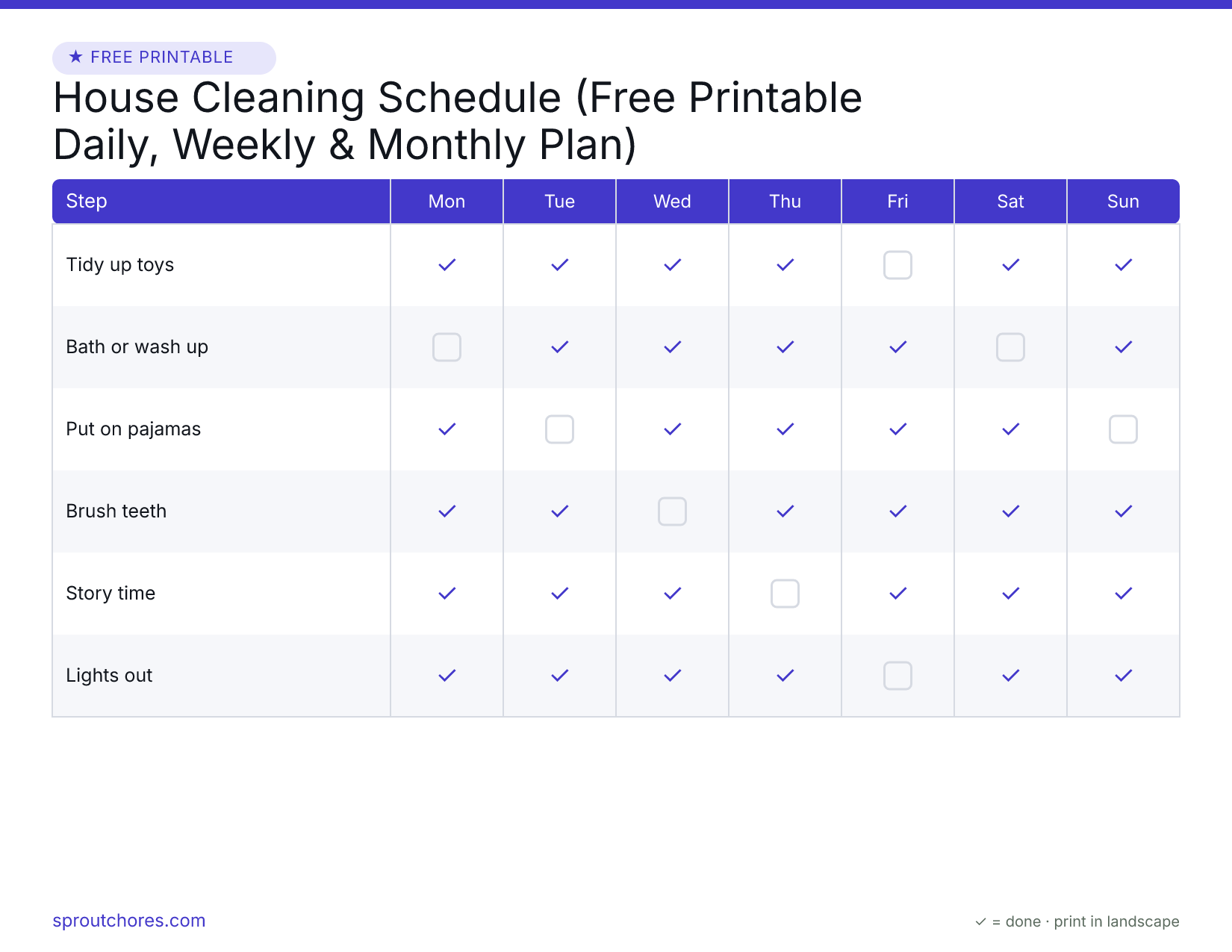
| Step | Mon | Tue | Wed | Thu | Fri | Sat | Sun | Remove |
|---|---|---|---|---|---|---|---|---|
| Tidy up toys | ||||||||
| Bath or wash up | ||||||||
| Put on pajamas | ||||||||
| Brush teeth | ||||||||
| Story time | ||||||||
| Lights out |
Tip: choose Landscape in the print dialog for the best fit.
Print in landscape for the best fit. A few reminders from our family to yours: do it together the first few times, keep the chart somewhere everyone can see it, and reward steady effort over a perfect job. — The SproutChores family
Want every age in one file? Get the free Age-by-Age Pack
Six printable charts (ages 4–10) plus reward and routine sheets, in one tidy PDF — free, straight to your inbox.
We email you new printables now and then — unsubscribe anytime. Privacy.
Something went wrong — please try again in a moment.
✓ Almost there — check your inbox!
We just emailed you a confirmation link. Click it to confirm, and your free Age-by-Age Chore Chart Pack lands in your inbox moments later.
Why splitting the work by cadence beats a marathon clean
The reason a single all-day cleaning blitz never sticks is that it treats every job as if it carries the same urgency. Wiping the kitchen counter and shampooing the carpet don't belong on the same to-do list — one keeps the day livable, the other can wait a season. When you flatten them together, the small daily things get buried under the big infrequent ones, so the house looks fine until it suddenly doesn't, and then you're back to the exhausting reset.
Sorting jobs by how often they actually need doing fixes the math. The daily column is a light touch — the surfaces and floors that gather the day's living and only take a few minutes to reset. The weekly column is the real maintenance, the bathrooms and floors and laundry that keep the home genuinely clean. The monthly column holds the deeper work you'd otherwise forget entirely until it's a problem. Spread across the week and month like that, no single day ever feels like a mountain, and the house stays in a narrow, comfortable band instead of swinging between spotless and overwhelming.
There's a mindset piece here too, and it's the one I'd stress most. In our home we don't frame keeping the house up as a chore in the drudgery sense — it's simply part of belonging to a household that everyone helps hold together. A written schedule makes that shared, because the work stops being a nag one person carries in their head and becomes a plain, visible plan the whole family can see and own.
How to use the printable schedule at home
Start in the maker above by laying out the rooms that make up your actual home, then assigning each task to the cadence that fits. Resist the urge to overload the daily column — if the everyday reset takes more than a few minutes per room, it won't survive a busy stretch, and a schedule that only works on easy weeks isn't much of a schedule. Keep daily light, put the honest maintenance on weekly, and let the deep, occasional jobs live on monthly where they belong.
Then print it and, more importantly, put it somewhere it'll actually be seen. A plan folded in a drawer does nothing; a plan on the fridge or inside a cabinet door where people pass it a dozen times a day quietly becomes the way the house runs. If more than one person shares the cleaning, a posted schedule earns its keep in a way no mental list can — it lets anyone step in and run the routine without a handoff conversation, so the work doesn't stall the moment the usual person is out or busy.
One small habit has probably saved us more household friction than any cleaning product: give a heads-up before a job needs doing rather than springing it on someone. "The bathrooms are on the schedule after lunch" lands completely differently than "go clean the bathroom right now." That little runway lets a person get their head around the task instead of feeling ambushed by it, and it heads off a startling amount of pushback. Use the schedule that way — as a shared plan everyone can see coming — and it feels far less like one person managing everybody else.
Building a plan that survives real life
Here's the mistake I watch people make over and over, and it has almost nothing to do with cleaning. They design a beautiful, ambitious system, run it perfectly for a week, and then real life shows up — a trip, a sick kid, a stretch where everything's on fire — the plan breaks for a few days, and they quietly decide the whole thing failed. It didn't fail. It just wasn't built to bend.
The best household systems aren't the most thorough ones; they're the ones that are easy to restart. Life will knock your schedule off the rails, and the only question that matters is how simply you can pick it back up. So build in slack on purpose. If a whole day gets away from you, the daily reset should be quick enough to catch up on tomorrow without penalty, and the weekly jobs forgiving enough that doing the bathrooms on Thursday instead of Wednesday changes nothing. A plan you can walk away from and return to without a big reset is worth far more than a perfect one that shames you the first time the week goes sideways.
And it helps to remember who the schedule is really for. In our house I've come to see routines like this less as a scoreboard and more as a tool for the adults running the show — a way to glance at the week and know whether the house is holding together or quietly drifting, without having to keep it all in your head. That mental unloading is half the point. When the plan is on the wall instead of rattling around in your mind, the low background hum of "I should really deal with that" gets a lot quieter.
Frequently asked questions
- What's the difference between daily, weekly, and monthly cleaning tasks?
- They're sorted by how fast the job comes back after you do it. Daily tasks are the light resets that keep the day livable — clearing counters, a quick tidy, the surfaces that gather the day's living — and they should take only a few minutes per room. Weekly tasks are the real maintenance that keeps the home genuinely clean, like bathrooms, floors, and laundry. Monthly tasks are the deeper work you'd otherwise forget until it becomes a problem. Splitting them this way keeps any single day from turning into a marathon, and the printable above lets you drop each task into the column that fits your home.
- How do I make a house cleaning schedule that I'll actually stick to?
- Keep the daily column genuinely light, and build the plan to be restarted rather than followed flawlessly. The systems that last aren't the most detailed ones — they're the ones you can walk away from during a busy or sick week and pick right back up without a big reset. Print it and post it somewhere you pass constantly, like the fridge or a cabinet door, so it becomes the way the house runs instead of something you have to remember. And keep it realistic: a schedule that only works on easy weeks won't survive the hard ones.
- How should a family or couple split up a house cleaning schedule?
- Put every job on paper first, including the invisible ones nobody volunteers for, then divide by who minds a task least, who's around when it needs doing, and who's genuinely better at it. A visible, posted schedule does the heavy lifting because it moves the tracking out of one person's head and onto the wall — anyone can see what's due and step in, so the work doesn't stall when the usual person is busy. In our home the framing is simple: keeping the place up is just part of belonging to a household everyone helps hold together, not a transaction. Giving each other a heads-up before a job, rather than springing it in the moment, removes most of the friction that turns into nagging.
- How do I get a free printable house cleaning schedule?
- Use the editable maker on this page: set your rooms, assign each task to the daily, weekly, or monthly column that matches how often it truly needs doing, and print it at home. There's no signup and nothing to pay. Start lean — a short daily reset, honest weekly maintenance, and just a few monthly deep-cleans — so the plan feels doable rather than punishing, and post it somewhere everyone in the house will actually see it.

About the author
More free printables
Get the free Age-by-Age Chore Chart Pack
Six printable charts (ages 4–10) plus reward and routine sheets, in one tidy PDF. We'll also send new printables and the occasional real parenting tip. The charts on this site are always free — no sign-up needed.
We email you new printables now and then — unsubscribe anytime. Privacy.
Something went wrong — please try again in a moment.
✓ Almost there — check your inbox!
We just emailed you a confirmation link. Click it to confirm, and your free Age-by-Age Chore Chart Pack lands in your inbox moments later.