Roommate Chore Chart: A Fair-Split Template for a Shared Home
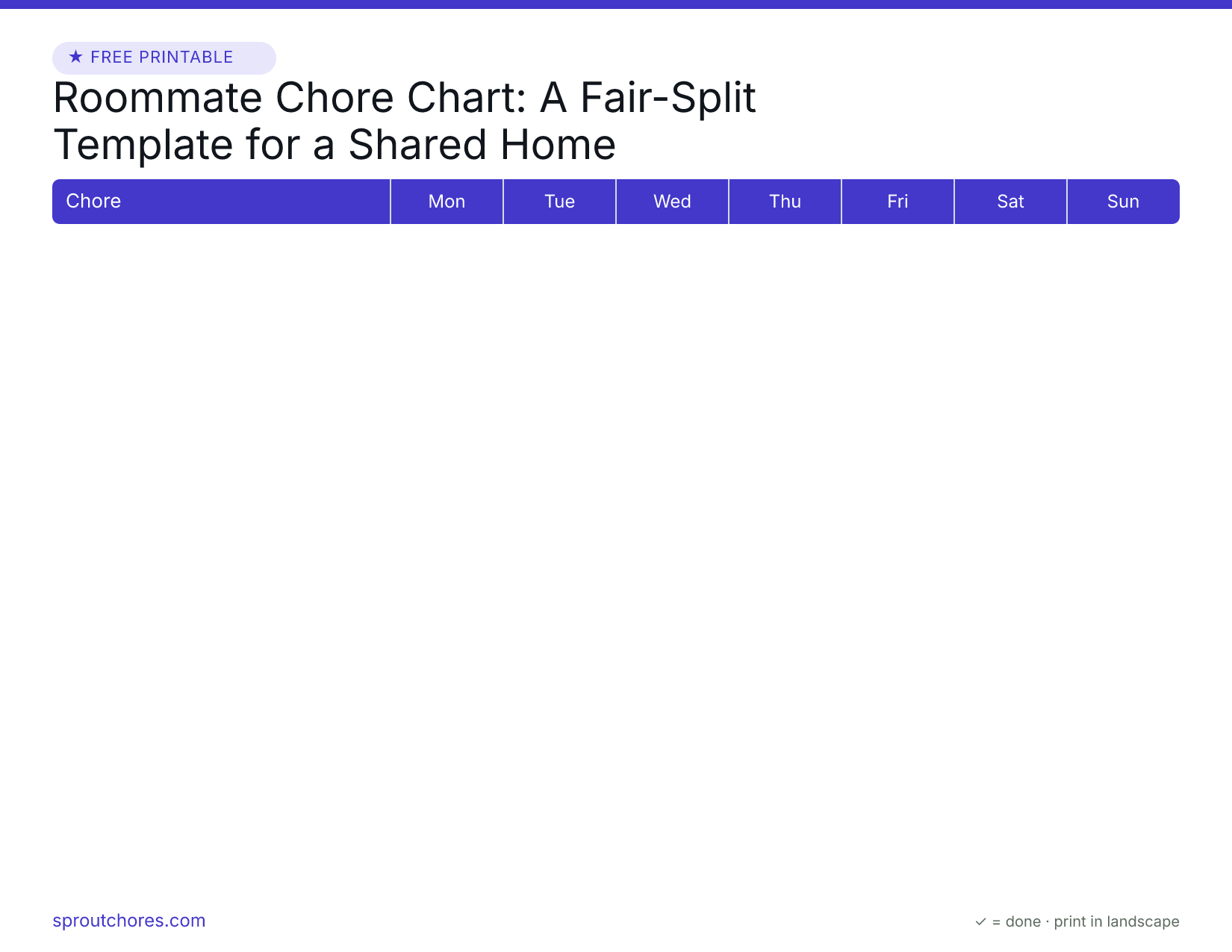
Search \"roommate chore chart\" and most of what comes back was clearly built for a family: parent-and-kid columns, sticker rewards, a cartoon sun next to \"make your bed.\" None of it fits a house of adults who chose to live together and just want the kitchen to stop being a standoff. I'm Andrew, a Marine Corps veteran, a dad of four, and a foster parent, and long before any of that the first chart I ever lived by was the one my brother and I used to divide our house growing up: two people, no boss, working out who handled what. That peer split is exactly the puzzle roommates face, minus the parent who eventually settles the argument. The generator below builds a blank, editable chart with a column for each person and a weekly rotation baked in, so no one owns the worst job forever. Nothing is filled in, and there's no login or signup to get through. You decide together what your place actually needs, drop in the tasks, and let the rotation keep it even. What follows is what I've learned about making a shared-home split hold up when there's no one in charge to enforce it.
| Chore | Mon | Tue | Wed | Thu | Fri | Sat | Sun | Remove |
|---|
Tip: choose Landscape in the print dialog for the best fit.
Print in landscape for the best fit. A few reminders from our family to yours: do it together the first few times, keep the chart somewhere everyone can see it, and reward steady effort over a perfect job. — The SproutChores family
Want every age in one file? Get the free Age-by-Age Pack
Six printable charts (ages 4–10) plus reward and routine sheets, in one tidy PDF — free, straight to your inbox.
We email you new printables now and then — unsubscribe anytime. Privacy.
Something went wrong — please try again in a moment.
✓ Almost there — check your inbox!
We just emailed you a confirmation link. Click it to confirm, and your free Age-by-Age Chore Chart Pack lands in your inbox moments later.
Agree on what "clean" means before you split anything
Every roommate walks in with a different baseline for clean, usually whatever the home they grew up in ran on. One person's "I'll get to it" is another person's "this is unlivable," and a chart can't resolve a disagreement you've never actually had out loud. So before you assign a single task, walk the shared spaces together and define two things: the standard and the cadence. What does "the kitchen is done" mean here? How often does the bathroom get a real clean? Is trash night Tuesday? Write the answers down where everyone can see them, because a standard that lives in only one roommate's head isn't a shared rule, it's a private grievance waiting to surface.
Just as important, scope the chart to common areas only: the kitchen, the bathroom, shared living space, trash and recycling, the floors everyone tracks through. Bedrooms are each person's own business. The moment a chore chart starts trying to legislate someone's personal space, it stops being a fair-split tool and becomes the thing you fight about. Keep it to the space you genuinely share, and it stays a peacekeeper instead of a weapon.
Rotate the jobs nobody wants
The quickest way resentment builds in a shared house isn't that chores exist, it's that the same person keeps getting stuck with the gross ones. If you hand the bathroom to whoever "doesn't really mind it" in September, by November they mind it plenty and feel like they got played. Rotation fixes fairness structurally instead of leaning on everyone's goodwill holding steady week after week. The template here rotates the columns for you, so the toilet, the trash, and the dish duty move down the line on a schedule you set rather than parking on one unlucky roommate.
A couple of things make a rotation actually work. Put the genuinely unpleasant jobs on a short cycle so they turn over weekly, and let the low-stakes stuff ride longer. And keep the rotation posted where all of you can see it, so "it's your turn" is a fact on the wall instead of one roommate's opinion. When my brother and I split the house as kids, the chart mattered less as a to-do list than as a neutral referee: it decided who did what before either of us had room to argue about it. A rotation does the same job for adults who don't have a parent around to make the call.
Let the chart do the nagging so no one becomes the house parent
In almost every shared house, one person cares the most and slowly gets drafted into being the unpaid manager, the one who notices, reminds, and quietly stews. That role burns through a friendship fast, because the reminding reads as bossiness and the not-doing reads as disrespect, and suddenly a pile of dishes is personal. The entire point of a posted chart is to move accountability off a person and onto a neutral system. When the bin is overflowing, you point at the board, not at your roommate: "the chart says it's your week," not "you never take the trash out."
Here's something I first learned raising kids that turns out to work on any adult: a surprise demand like "do the dishes right now" gets defensiveness from literally anyone, but a heads-up like "just a reminder, it's your kitchen night" gives a brain time to shift gears, and most of the friction evaporates. A chart on the wall is advance notice by design, no ambush required. And the deeper principle carries over too: you don't get cooperation by lecturing people, you get it by handing everyone a clear system and letting it hold the line. Give your roommates the tool and let it do the enforcing so none of you has to play the villain.
Build it to restart, because it will fall apart
The biggest reason a roommate cleaning schedule fails isn't laziness, it's that people build one for a perfect week that never arrives. Finals week hits, someone's slammed at work, a roommate travels, and the chart goes untouched for ten days. The houses that give up are the ones who decide a lapse means the whole thing was pointless. It wasn't. It just ran into real life, which every system eventually does. Design for the restart: keep the chart short enough that you can realistically climb back on after a rough stretch, and when it slips, print a fresh page and pick it back up rather than relitigating every missed turn. Build in a little slack while you're at it, like a swap rule so a roommate buried under a deadline can trade a week instead of quietly blowing it off.
One last thing, learned the hard way in a busy house: when something does go sideways and you're annoyed, don't try to hash it out in the heat of the moment. A frustrated brain goes looking for someone to blame and lands on whoever's standing there, which is your roommate, and nothing you negotiate while irritated actually holds. Cool off first, then sort it at a quick house check-in when everyone's level. Let the chart carry the memory so the hard conversation doesn't have to land at the worst possible time.
Frequently asked questions
- How do you make a fair roommate chore chart?
- Fair almost never means an identical split, it means a transparent and rotating one. Start by listing everything your shared space actually requires, then agree out loud on what "clean" means and how often each job happens. Divide by the reality of your schedules rather than by who complains least, and rotate the unpleasant jobs so no one is permanently stuck with the bathroom or the trash. The roommate chore chart template here is built for exactly that: a blank column for each person that you fill in together, plus a weekly rotation so the worst tasks move down the line instead of parking on one roommate.
- How should college roommates split chores?
- College is the hardest case because everyone's schedule is chaotic and the system is guaranteed to lapse during exams. That's fine if you plan for it. Keep the chore chart for college roommates short and limited to common areas only, rotate the jobs weekly so no one feels singled out, and post it somewhere everyone actually passes, like the fridge or the bathroom door. Add a swap rule so a roommate slammed by a deadline can trade a week rather than silently skip it, and when the chart falls off during a busy stretch, just print a fresh one and restart. A schedule you can easily get back on beats a perfect one you abandon.
- What chores should go on a shared roommate chart?
- Only the shared work. Put the common areas on the chart, the kitchen (dishes, counters, floor), the bathroom, shared living space, trash and recycling, and shared floors, plus anything communal like restocking cleaning supplies or common paper goods. Leave personal bedrooms off entirely, since trying to police a roommate's own space is how a chart turns into a fight. Because the generator gives you a blank, editable grid rather than a fixed list, the best move is to walk your common spaces together and write down what actually gets dirty in your place, then split and rotate those specific tasks.

About the author
More free printables
Get the free Age-by-Age Chore Chart Pack
Six printable charts (ages 4–10) plus reward and routine sheets, in one tidy PDF. We'll also send new printables and the occasional real parenting tip. The charts on this site are always free — no sign-up needed.
We email you new printables now and then — unsubscribe anytime. Privacy.
Something went wrong — please try again in a moment.
✓ Almost there — check your inbox!
We just emailed you a confirmation link. Click it to confirm, and your free Age-by-Age Chore Chart Pack lands in your inbox moments later.