Reward Chart for Toddlers (Free Printable, Picture-Based for Pre-Readers)
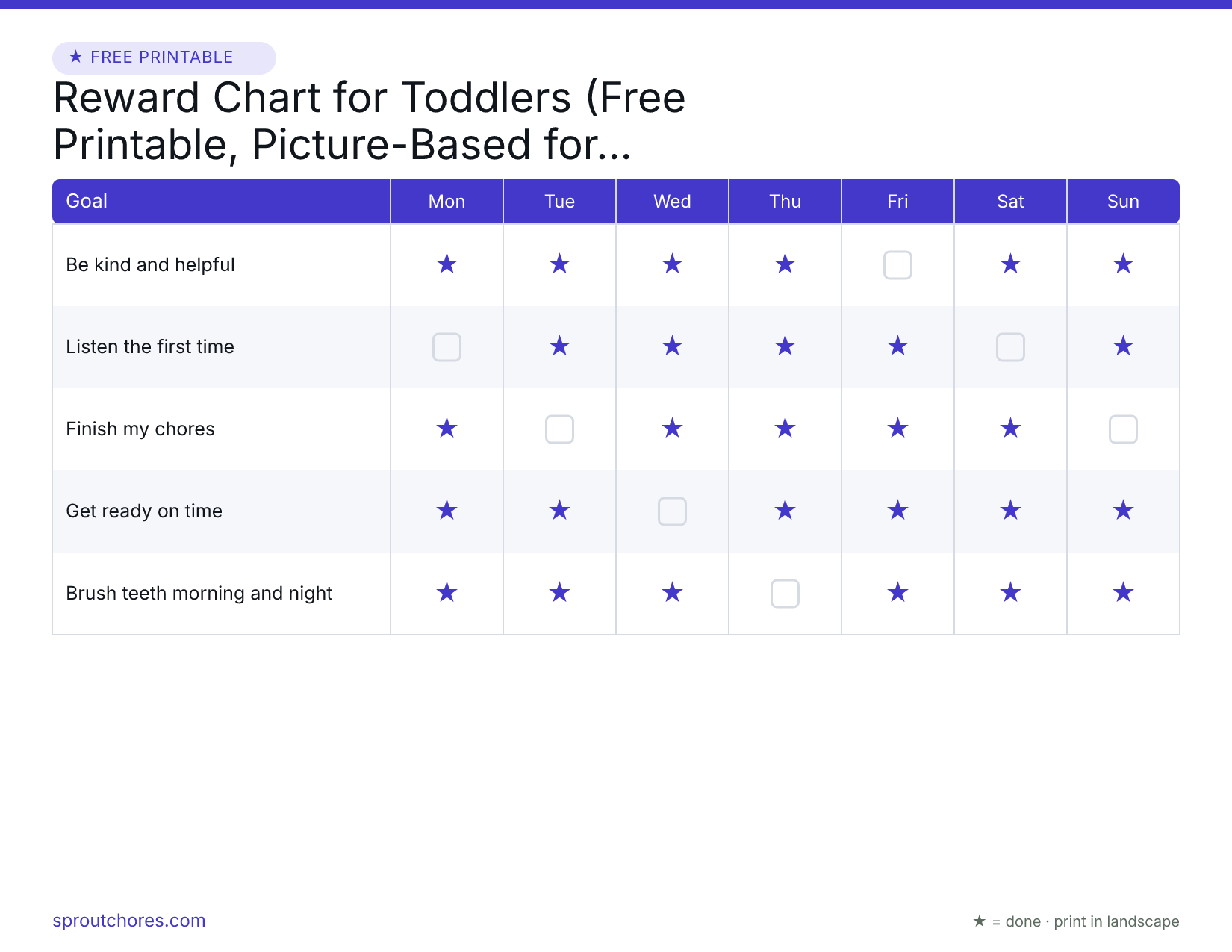
A toddler can't read a to-do list, but they can absolutely understand a picture — and that's the whole idea behind this chart. The generator below builds a simple grid: a short stack of everyday goals down the side, the days of the week across the top, and a star for your little one to earn in each square. Because it's made for two-, three-, and four-year-olds who aren't reading yet, every goal shows up as an icon they can recognize on sight, so nobody has to read the chart to them. Set it up, print it for the fridge or a bedroom wall, and you're done in under a minute. Before you do, a bit of straight talk from our house. I'm Andrew — dad to four, now aged 9 through 18, and with my wife a foster parent to several little ones over the years — so we've filled in our share of these grids. Here's what we've come to believe: a reward chart is really a window for you, the parent, not a paycheck for your child. It gives you a week-at-a-glance read on how a new habit is landing, and it hands a toddler something cheerful to aim at while that habit is still forming. What it can't do is manufacture lasting motivation — that grows out of being part of a family where everyone pitches in, not out of a prize. Hold it that lightly and it earns its spot on the wall. Build yours below, then read on for how we'd use it.
| Goal | Mon | Tue | Wed | Thu | Fri | Sat | Sun | Remove |
|---|---|---|---|---|---|---|---|---|
| Be kind and helpful | ||||||||
| Listen the first time | ||||||||
| Finish my chores | ||||||||
| Get ready on time | ||||||||
| Brush teeth morning and night |
Tip: choose Landscape in the print dialog for the best fit.
Print in landscape for the best fit. A few reminders from our family to yours: do it together the first few times, keep the chart somewhere everyone can see it, and reward steady effort over a perfect job. — The SproutChores family
Want every age in one file? Get the free Age-by-Age Pack
Six printable charts (ages 4–10) plus reward and routine sheets, in one tidy PDF — free, straight to your inbox.
We email you new printables now and then — unsubscribe anytime. Privacy.
Something went wrong — please try again in a moment.
✓ Almost there — check your inbox!
We just emailed you a confirmation link. Click it to confirm, and your free Age-by-Age Chore Chart Pack lands in your inbox moments later.
How to set up a toddler reward chart that actually gets used
Start with placement, because for a toddler it decides everything. A chart tucked in a drawer or hung where only you can see it may as well not exist; put it low, at your child's eye height, in the room where the habit happens, and it quietly does its job all day. Keep the goal list tiny. One to three pictures is plenty at this age — a grid crammed with expectations just becomes wallpaper everyone ignores, parents included. Lean on the icons rather than words, since a toddler reads faces and pictures long before letters, and a familiar image tells them what a square is for without a grown-up narrating it.
Timing is the other thing little kids force you to get right. A two-year-old can't connect a star to something that happened before lunch, so the star has to land the instant the good thing happens, while the moment is still warm — otherwise it's just a shiny sticker with no meaning attached. One move that has headed off more standoffs in our home than any reward ever did is a simple heads-up before the moment arrives. Springing "time to brush!" on a toddler mid-play invites a fight; "in a few minutes we're going to brush, and then you get your star" gives their brain a runway to land on. And whatever you do, let the chart only ever move forward. Peeling a star back after a rough afternoon turns the chart into something your toddler feels they're losing at, and at this age a bad stretch usually isn't defiance — it's a tired, overwhelmed little body. Celebrate the wins on the chart and handle the hard moments off it, face to face.
Choosing rewards for a 2-to-4-year-old
With a toddler, the reward that lands hardest often isn't an object at all — it's your face. A genuine "you did it!", a clap, a hug in the moment tends to beat anything you could buy, and it never runs out or inflates in price. So reach for warmth first. When you do want something you can hold, smaller and more often beats big and rare every time; a sticker the child gets to pick and press on themselves is frequently the whole reward, because the choosing and the pressing is half the fun. If you want a slightly bigger payoff for a good run, the version that worked for our own kids was almost embarrassingly cheap — a small bin of dollar-store trinkets they could choose from now and then. Because nothing in it cost much, we never had to ration it or turn handing one over into a negotiation, and each pick still felt like a real treat.
A couple of lines we'd hold firmly. We keep the reward chart clear of the everyday things a toddler does simply because they belong to the household — getting dressed, helping tidy the mess they just made — because those aren't a job we pay out for; they're just how a family works together. And we never made screen time something a child had to earn through the chart. Once screens or ordinary fun become the currency, regular family life starts to feel like a string of transactions, and that's a hard knot to untie later. Think of the prize as a small, short-lived boost that gives a brand-new habit a bit of extra shine — not the reason your child does the thing, because that reason needs to end up being their own.
When the chart doesn't click: routine beats pressure
Not every toddler cares about a chart, and that's worth knowing before you stake too much on it. We have one child who fell in love with a sticker grid and would tug us over to fill in her square, and another who could not have cared less that it was on the wall — same house, wired completely differently. If yours falls in the second camp, don't force the chart to be something it isn't for that child; lean on a steady routine and your own encouragement instead.
This is where the most useful thing we ever learned about little kids comes in, and we learned it while fostering. The children who came to us had known almost no dependable rhythm before, and what settled them was never a reward on a wall — it was knowing exactly what came next. Once the same steps arrived in the same order each evening — wind-down, bath, books, bed — the resistance we'd been reading as stubbornness mostly dissolved, because a lot of what looks like a toddler digging in is really a toddler who feels unsure. A predictable pattern gave them something a prize never could: the sense that they were safe. The same holds for any two- or three-year-old. And when a toddler tips into a full meltdown, no chart and no sticker is going to reach them in that moment — an overwhelmed little body can't take in reasoning until it has calmed down. Help them settle first, then carry on.
All of which points back to what the chart is really for. It was never mainly there to motivate your child; its steady job is to let you read the week — to see which habit is clicking and which one keeps slipping — so you know where to lean in and where to ease off. It's your read on how things are going, not a score your toddler is chasing.
Knowing when to let the chart go
A toddler reward chart is a temporary prop — it's there to hold a habit up until the habit can hold itself. The signal to take it down is happy and ordinary: your child just brushes, or gets dressed, or climbs into bed without the chart being part of the conversation anymore. When the habit has stopped being an event, the chart has done its work. There's no need for a big finale. We tend to just let the stars taper off, mention them less, and ease back the little rewards before the chart itself comes down, so the new habit gets a chance to stand without the prize propping it up.
Two things to make peace with. Toddlers backslide when they're tired, teething, or thrown off by a busy week, so don't read a rough patch as the system failing; the best routines aren't the flawless ones, they're the ones you can pick back up in five minutes after life knocks them over. And don't judge any of this day to day. Real change in a small child is almost invisible up close — you only notice it looking back. Our youngest is a good example: he now hauls every bag of trash in the house out on his own, no reminders, and that didn't show up in one proud week of stickers. It grew out of years of the same calm expectations. That's the quiet thing your chart is building toward. A star on the wall can carry a new habit through its shaky first weeks, which is genuinely worth something — but what makes it stick is your child's own budding pride in being a little more capable, and their sense that they're a needed part of the family. Once that's landed, the chart has worked itself out of a job, which was the plan all along.
Frequently asked questions
- What age can a toddler use a reward chart?
- Reward charts tend to work well from about age two through four, once a toddler can recognize a picture and feel the little thrill of earning a star. Because kids this age aren't reading yet, a picture-based chart matters — the icons let them understand each goal on sight rather than waiting for you to read it. Keep your expectations modest, though: at this stage the chart is more about gently building a habit than producing tidy results, and you'll still be doing plenty of the work yourself. Some toddlers light up at a sticker grid and others barely notice it, and both are completely normal, so lean on a steady routine and warm encouragement either way.
- Do reward charts actually work for toddlers?
- They can help, but not quite the way the packaging suggests. In our experience the sticker itself doesn't create motivation — it gives a brand-new habit a little extra cheer while it's forming, and it hands you a clear week-at-a-glance read on how things are going. Used as a short, upbeat nudge rather than a payment plan, a chart earns its place on the wall. What it can't do is manufacture lasting drive; that grows from a toddler feeling capable and feeling like a genuine part of the household. So treat the chart as a helpful tool for you and a bit of fun for your child, keep it clear of the everyday jobs everyone pitches in on, and don't be discouraged when the stars eventually lose their shine — that usually means the habit has stuck.
- What are good rewards for a toddler reward chart?
- Smaller and more frequent beats big and rare with toddlers, and honestly your genuine delight is often the strongest reward of all. A sticker the child gets to choose and press on themselves is usually plenty, since the choosing and pressing is half the fun. If you want a step up for a good stretch, keep it in the spirit of a cheap dollar-store treasure box — little trinkets you never have to ration or argue over. Reach for time and connection over a pile of stuff: an extra bedtime story or a few minutes of a favorite game with you often lands better than another plastic toy. And keep the reward well clear of the everyday things a toddler does as part of the family, so it stays a small treat rather than a wage.
- How do I get a free printable toddler reward chart?
- Use the editable chart on this page: choose your goals, keep them shown as pictures so your pre-reader can follow along on their own, and print it at home for the fridge or a bedroom wall. There's no signup and nothing to pay. It works just as well for a 3-year-old or a 4-year-old — simply start a younger toddler with one or two goals so the chart feels doable, then add a row or two later as they're ready for the next habit.

About the author
More free printables
Get the free Age-by-Age Chore Chart Pack
Six printable charts (ages 4–10) plus reward and routine sheets, in one tidy PDF. We'll also send new printables and the occasional real parenting tip. The charts on this site are always free — no sign-up needed.
We email you new printables now and then — unsubscribe anytime. Privacy.
Something went wrong — please try again in a moment.
✓ Almost there — check your inbox!
We just emailed you a confirmation link. Click it to confirm, and your free Age-by-Age Chore Chart Pack lands in your inbox moments later.